:::::::::::::::::::::::::::::::::::::::::::::::::::::::::::::::::::::::::::::::::::::::::::::::::::::
Suiteki, Water Dripper 水滴
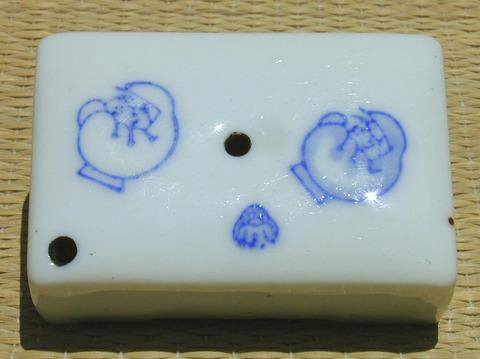
My Collection
Introduction to Japanese Calligraphy
The knowledge of calligraphy is an important step in the understanding of Japanese culture. Calligraphy is not merely an exercise in good handwriting, but rather the foremost art form of the Orient. It is the combination of the skill and imagination of the person who has studied intensely the combinations available using only lines. In the West, calligraphy was intended to suppress individuality and produce a uniform style. Japanese calligraphy (sho 書) attempts to bring words to life, and endow them with character. Styles are highly individualistic, differing from person to person. Japanese calligraphy presents a problem for westerners trying to understand it; the work is completed in a matter of seconds so the uninitiated cannot really appreciate the degree of difficulty involved. However, bear in mind that the characters must be written only once. There is no altering, touching up, or adding to them afterwards.
Various types of Chinese-character scripts, or shotai, representing the historical development of writing in China, are practiced, such as tensho or archaic script, and Reisho or clerical script. More common is kaisho or block-style script, perhaps the most popular style, since the characters are easily recognizable. Gyoosho or running-style script is created by a faster movement of the brush and some consequent abbreviation of the character. Soosho or grass-writing is a true cursive style that abbreviates and links parts of a character, resulting in fluid and curvilinear writing.
More
http://metrotel.co.uk/calligraphy/intro1.html
Water Droppers (Suiteki 水滴)
Now let us take a closer look at the water droppers. They come in many forms and shapes, usually made from ceramics or metal.
:::::::::::::::::::::::::::::::::::::::::::::::::::::::::::::::::::::::::::::::::::::::::::::::::::::
Suiteki, Water Dripper from Imari 伊万里の水滴
http://blog.livedoor.jp/gabigreve2000/archives/22555331.html
Suiteki Water Dripper 水滴 like Daruma
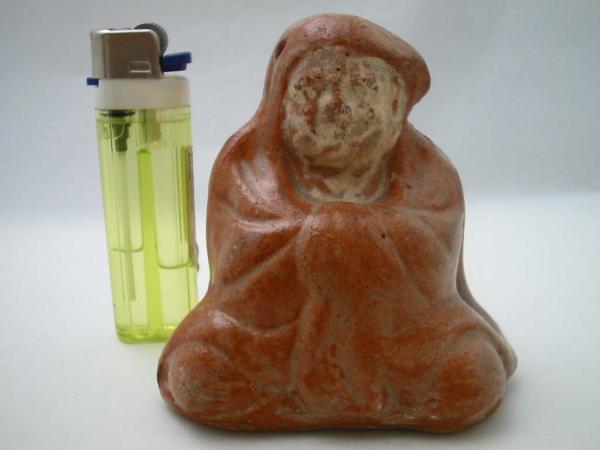
. . . CLICK here for Photos of many more samples !
:::::::::::::::::::::::::::::::::::::::::::::::::::::::::::::::::::::::::::::::::::::::::::::::::::::
Pottery from Tokoname 常滑焼
5.5 cm high, 6.3 cm diameter

Photo from my friend Ishino.
:::::::::::::::::::::::::::::::::::::::::::::::::::::::::::::::::::::::::::::::::::::::::::::::::::::
From Pottery


Photos from my friend Ishino.
:::::::::::::::::::::::::::::::::::::::::::::::::::::::::::::::::::::::::::::::::::::::::::::::::::::
Princess Daruma
from Ofuke-Yaki pottery
御深井姫だる
Diameter about 5,5 cm

Photos from my friend Ishino.
Ofuke-yaki 御深井焼 is from an old kiln of Nagoya, adjacent to the castle.
(おふけ)
quote
In the year 15 of Keicho Era (1610), feudal lord of Owari Tokugawa clan, Mr. Yoshinao Tokugawa (Mr. Ieyasu Tokugawa's child) called to Akazu village (present Akazu, Seto City) for revival of Akazu kiln, the potter who had come out to other districts to avoid war.
In the year 2 of Genwa Era (1616), Yoshinao Tokugawa invited into Nagoya Castle, two
potters in Akazu village, Nihei and Tousaburo, to build a kiln at "Ofuke-maru" (a place inside the castle) for firing "Oniwa-yaki"earthenware. Later, Tahei, potter in Akazu joined and the three potters were called the big three or "Okamaya".
Akazuware have been fired in same way as ancient technology and technique. This is because the above big three "Okamaya" were going to Nagoya Castle to fire "Oniwa-yaki" until "Oniwa-yaki" had been abolished at a law of replacing "Han" (feudal domain) with "Ken" (Prefecture) in Meiji Era. This should reflect support from great Tokugawa Clan. Different from "Oniwa-yaki", "Ofuke-yaki" earthenware was instructed by Mr. Chin Gen Pin (naturalized Japanese from China). "Ofuke-yaki" was fired wtih light blue ash glaze and with decoration manner called "Annan-Gosue".
This light blue ash glaze is called "Ofuke-yu" considred to be most difficult one of the glazes in Akazuware.
© setodrgn, 2002
:::::::::::::::::::::::::::::::::::::::::::::::::::::::::::::::::::::::::::::::::::::::::::::::::::::
Suiteki - Water Dropper, Hiraga Gennai and Daruma
水滴,平賀源内と達磨

Let me introduce you to one of my favorite free spirits of the Edo period.
Meet Hiraga Gennai (1728 - 80), a famous naturalist, experimentator, inventor and writer.
He was born in the Takamatsu domain as the son of a low-ranking samurai, moved to Nagasaki to study herbal medicine and in 1757 went to Edo to continue his studies and to write humorous books. He experimented with many natural substances, trying to make cloth of asbestos, thermometers and Dutch-style pottery. Soon he made his own style, Gennai-yaki. His activities included surveys for ore deposits, wool manufacturing and Western oil painting with other Akita painters. He also experimented with electricity and tried his hand at many inventions.
In his later years he showed signs of psychological deterioration and died in prison after he killed one of his disciples in a fit of madness in 1779.
He is still well known today as a searching spirit and great experimentor and researcher of nature.
The Gennai kiln is believed to have opened in the mid Edo period (Hoeki Era, 1753-63) in Kagawa prefecture. The kiln produced a lightweight pottery in a style of South Chinese wares, and is best known for low relief plates depicting maps of Japan in typical Gennai glazing of yellow, brown and green.
From his bout with pottery we have this small water dropper in the form of a reclining Daruma in three colors 三彩達磨. This or similar forms of a Daruma leaning back are still used today in Kutani, as you can see from the piece of my collection.

It is customary to eat broiled eel on the day of the ox in summer (doyoo no ushi no hi, sometime in late July). This is because eel (unagi) is nutritious and rich in vitamin A, and provides strength and vitality to fight against the extremely hot and humid summer of Japan. The man who invented this well-loved custom is the famous scientist of the late Edo period, Hiraga Gennai.
. . . Doyoo 土用 Dog Days and eating eel
Here is a short report about Gennai'a experiments with electricity, a subject that fascinated him greatly.
Elekiter (Photograph/Appointed as an important cultural asset in 1997)
Hiraga Gennai witnessed the demonstration of "Elekiter" on his second visit to Nagasaki in 1770 and he made up his mind to reproduce it. The mechanism that induces static electricity by rotating a handle in the side of a box is reported to have obtained a great popularity as "A Wonderful Thing" in Edo at that time.

Inbanuma Kantaku 印旛沼干拓 Inba-Numa land reclamation
Hiraga Gennai was involved in the project of drying out the swamp at Inbanuma along the river Tonegawa 利根川 for land reclamation.
Legend knows that Gennai died because of a curse of the Demon of the Swamp.
Lake Inbanuma was created by the natural damming of a small valley in the Shimosa Plateau, Chiba, and originally covered 21.3 square kilometres. After land reclamation projects, similar to those carried out on the swamp Teganuma, it now covers 13.1 square kilometres.
.................................................................................
Hiraga Gennai, the spirit of Tokugawa genius
Receiving orders from clans (han) of the Tokugawa Era, Hiraga Gennai, an early exponent of so-called Dutch learning (rangaku) during the Tokugawa Period, created fireproof coats. He also produced "Electriciteit" (electricity) by applying ideas imported from Holland to create a friction generator for medical purposes. Hiraga's ingenious creativity still inspires us today. Using the powers of imagination to create new things --- the spirit of Hiraga Gennai lives on at Hiraga Machinery Mfg. Co., Ltd.
http://www.hiraga.co.jp/eng/
:::::::::::::::::::::::::::::::::::::::::::::::::::::::::::::::::::::::::::::::::::::::::::::::::::::::::::::::::::::::::::
The latest development - November 2015
The financial supporter of Gennai was (most probably) the lord of Takamatsu domaine,
Matsudaira Yoritaka 松平頼恭 (1711 - 71).
Other sourced point to his relationship with the Governor in Edo
. Tanuma Okitsugu 田沼意次 (1719 - 1788) .
Yoritaka had an interest in science himself:
Illustrated book of fish and aquatic animals
compiled by Matsudaira Yoritaka, the Lord of Takamatsu in 18th century Japan.
Matsudaira Yoritaka noticed Gennai's abilities in cultivating ginseng — an activity in which Lord Yoritaka enthusiastically participated . . .
- further reference -
Japan: The Dutch Experience
By Grant Kohn Goodman
- source : books.google.co.jp -
Early Modern Japanese Literature: An Anthology, 1600-1900
By Haruo Shirane
- source : books.google.co.jp -
It seems he did not really "invent" most of the items related with his studies, but got them from the Dutch in Nagasaki or read about them in European books and repaired things as best as he could.
Nihon no Da Vinci 日本のダ・ヴィンチ
江戸時代中期、巷ではある男の発明が話題をさらっていた・・・
平賀源内。日本を代表する発明家であり、一般的にエレキテルを発明した事で知られ、
『日本のダ・ヴィンチ』とも呼ばれる。
しかし、その素顔は意外と知られていない・・・
高松藩御蔵番・白石茂左衛門の三男として生まれ、本草学(薬学)を学ぶ。
その知識が買われ、長崎へ遊学。
そこで日本を圧倒する海外の科学技術を目の当たりにした源内は、
研究の自由を求め高松藩を脱藩。
浪人となった彼は蘭学を学ぶ為江戸へと向かうのだった・・・。
江戸での活躍、蘭学、数々の発明、生涯の親友・杉田玄白との出会い・・・
そんな源内が発明した品々にある疑惑が浮かび上がってきた!
平賀源内は“発明家”ではなかった!?
一介の浪人に過ぎない源内が、なぜ研究に没頭できたのか?
明らかになる資金源と彼を動かしていた影の人物の存在。
そして源内には数々の奇行が?現代医学で行動を分析!
すると意外な事実が・
- source : www.bs4.jp/hsi - Ainosuke -
............................................................................
- Books by Hiraga Gennai -
Rootless Weeds (根無し草 Nenashigusa) 1763
In Gennai's Rootless Weeds, which gives a comic twist to this incident, Enma, the king of hell, falls in love with a picture of Segawa Kikunojo ... The Dragon God, who has been asked by Enma to find Kikunojō, a kappa (water spirit) takes the shape of a young samurai ...
- source : Haruo Shirane google books -
A Sequel to Rootless Weeds (Nenashigusa kōhen) in 1769
Fûryû Shidôken den 風流志道軒伝 The tale of dashing Shidoken
(1763)
:::::::::::::::::::::::::::::::::::::::::::::::::::::::::::::::::::::::::::::::::::::::::::::::::::::::::::::::::::::::::::
[ . BACK to DARUMA MUSEUM TOP . ]
[ . BACK to WORLDKIGO . TOP . ]
- #hiragagennai #gennai -
:::::::::::::::::::::::::::::::::::::::::::::::::::::::::::::::::::::::::::::::::::::::::::::::::::::::::::::::::::::::::::



 Posts
Posts



1 comment:
Edo Kanda Shirakabechoo 神田白壁町 Shirakabe-Cho district in Edo
lit. "white wall district".
Most plasterers lived in these two districts, 上 and 下.
Hiraga Gennai lived here.
Post a Comment