:::::::::::::::::::::::::::::::::::::::::::::::::::::::::::::::::::::::::::::::::::::::::::::::::::::
Daruma and the Courtesans,
Onna Daruma, Oiran and Daruma
芸者,花魁とだるま、女だるま
Daruma as a lady, Daruma with the ladies...
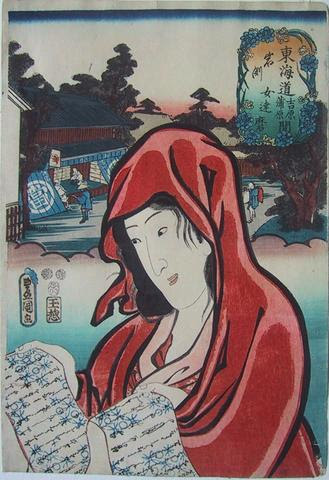
Iwabuchi Onna-Daruma, Daruma as a Courtesan
... ... ... 岩淵の女達磨
Utagawa Kunisada (1786-1864)
The background showing a landscape between stations Kanbara and Yoshiwara on the Tôkaidô road, from the series Tôkaidô comparing popular figures with stations of the Tôkaidô (Tookaidoo).
Curtesy to Asian Art. Look at more of their phantastic prints.
http://www.asianartschmitz.de/englisch/holzschnitte.html
:::::::::::::::::::::::::::::::::::::::::::::::::::::::::::::::::::::::::::::::::::::::::::::::::::::
Oiran (花魁, Oiran)
were high-class courtesans in Japan. The word "oiran" consists of two kanji, 花 meaning "flower", and 魁 meaning "leader" or "first." Cultural aspects of oiran traditions continue to be preserved to this day.
The oiran arose in the Edo period, 1600 - 1868. At this time, laws were passed restricting brothels to walled districts set some distance from the city center. In the major cities these were the Shimabara in Kyoto, the Shimmachi in Osaka, and in Edo, the Yoshiwara. These rapidly grew into large, self-contained "Pleasure Quarters" offering all manner of entertainments. Within, a courtesan's birth rank held no distinction but there arose a strict hierarchy according to beauty, character, educational attainments and artistic skills.
Among the oiran, the tayū (太夫 or 大夫, tayū) was considered the highest rank of courtesan or prostitute, and were considered suitable for the daimyo. Only the wealthiest and highest ranking could hope to patronise them.
© More in the WIKIPEDIA !
. nanshoku、danshoku 男色 homosexuality in Edo .
:::::::::::::::::::::::::::::::::::::::::::::::::::::::::::::::::::::::::::::::::::::::::::::::::::::
ONNA DARUMA女達磨 was a popular theme.
Onna Daruma also comes as a Netsuke.

For the little secret under her skirt, see here:
http://www2s.biglobe.ne.jp/~musasi01/netuke/203/daru.htm
http://www.flickr.com/photos/gabigreve2000/640985313/
.......................................................................
We also have the story of a courtesan who commented about Daruma
"Well, he was sitting in quiet meditation for nine years, but we here have to sit and suffer in the Noisy Pleasure Quarters for more than ten years!"
The painter Hanabusa Itchoo made a picture of the curtesan, which became the model of the Princess Daruma Dolls.
. Hanabusa Itchoo, Itchō 英一蝶 Hanabusa Itcho . (1652 – 1724)
With a Daruma Painting.
:::::::::::::::::::::::::::::::::::::::::::::::::::::::::::::::::::::::::::::::::::::::::::::::::::::
Read about the courtesans in the Yoshiwara quarters of Old Edo and their connection with our Daruma.
Another courtesan that Bunkoo speaks about is Rizen. Sold to the Oomiya brothel by her husband, a pharmacist by the name of Kuwanaya Yasoo, Rizen "had a kind heart, was deeply compassionate, and professed a strong faith in Boddhisatva Samantabhadra (Fugen bosatsu)." Bunkoo presents her as being more devout than most of the Buddhist monks.He reminds his listeners, who may have been shocked at his associating a prostitute with a boddhisatva, that Samantabhadra, while riding a white elephant, had actually revealed himself to his devotees in the form of a prostitute.
Bunkoo also spoke aboutr a Buddhist monk of the Heian period, Shookuu (910-1007), who taught that "if one wants to worship Samantabhadra, he should go to Harima to see the singing and dancing of the courtesans." Bunkoo's conjunction of boddhisatvas and courtesans was meant to shock his listeners and also to satirically expose hypocritical Buddhist monks.
In his strong defense and praise of Rizen, Bunkoo argues that
"Daruma Buddha faced the wall sitting in meditation for nine years. But the courtesan Rizen spent not nine, but ten years confined to her place of business, facing the wall, season after season all day long."
Bunkoo admitted that his inspiration for this insight had come from Hanabusa Itchoo. The artist had employed the same type of contrast in his paintings. He once painted the face of a courtesan on the body of the Daruma.
This painting of a female Daruma, holding a fan and tobacco pouch and dressed like a courtesan, was a visual expression of the incongruity and contrast of which Bunkoo was so fond. On Hanabusa's painting were written the words: "What is nine years of suffering
compared with ten years of prostitution?"
Read this great story about
Violating Censorship: Humor and Virulence in the Popular Writings of Baba Bunkoo (1715-1759)
William J. Farge Loyola University, New Orleans
http://web.aall.ufl.edu/SJS/Bunko.html
Safety Copy of this article
http://groups.yahoo.com/group/DarumaArchives-002/message/41
- - - - -
. tamagouri, tamago uri 玉子売り / 卵売り vendor of eggs .
selling boiled eggs around Yoshiwara
:::::::::::::::::::::::::::::::::::::::::::::::::::::::::::::::::::::::::::::::::::::::::::::::::::::
Civilized Daruma by Tsukioka Yoshitoshi

http://www.davidrumsey.com/amico/amico9102234-73351.html
:::::::::::::::::::::::::::::::::::::::::::::::::::::::::::::::::::::::::::::::::::::::::::::::::::::
Daruma/Kannon by Seki Yuho (1900-1982)
The two pillars of Buddhism are insight—symbolized by the Grand Patriarch Daruma-and compassion—represented by the Goddess Kannon.
The mark of a true Zen master is to be able to identify with both the masculine and feminine aspects of Buddha-nature, and indeed such great teachers as Hakuin, Sengai, and Tesshu were able to paint Daruma and Kannon equally well. In this painting we have both Zen teachers together, a real treat.
About the Artist
Seki Yuho was born in Fukuoka. He became abbot of the major Zen temple Eigenji in 1956, and frequently traveled overseas to give instruction in Zen. Yuho wrote a number of books, including one entitled Die Once, and You Won't Die Again. He was a proflic Zen artist, both calligraphy and painting.
http://www.shambhala.com/zenart/html/gallery/detail/d31.cfm
:::::::::::::::::::::::::::::::::::::::::::::::::::::::::::::::::::::::::::::::::::::::::::::::::::::
Kitagawa Utamaro (1754-1806)

A seller of fan-papers ( jigami-uri ) and a young beauty from an untitled series of eight prints published c1797 by Tsuruya Kiemon. The idealised itinerant merchant has black fan-shaped lacquer boxes perched on his shoulder. In his hand he holds a fan with an image of Daruma eyeing the couple.
http://www.ukiyo-e.demon.co.uk/beauties.htm
Look at this detail of the Daruma enjoying himself
(from Farland Collection)

. jigami uri 地紙売り in Edo .
jigami uri 地紙売り kagema boys selling paper for fans and talking about kabuki
:::::::::::::::::::::::::::::::::::::::::::::::::::::::::::::::::::::::::::::::::::::::::::::::::::::
Let us read a paragraph from DARUMA
by Neill McFarland.
A common theme is the pairing of Daruma with a woman. Typically in the woodblock prints, the woman is identified as a courtesan. Young, beautiful and gorgeously attired, she is demure,but also emotionless - perhaps, one could say,as calm and self-sufficient as a Zen monk. Daruma, on the other hand, traditionally so stolid, here is the epitome of discomfiture. His gargling eyes, otherwise symbols of outward alertness and inner awareness, now bug at th eunaccustomed distraction and attraction of the female presence.
His whole demeanor suggests rather incriminatingly that, for all his vaunted self-discipline, this most austere personage must content with a residue of human passion.
Daruma is also present with courtesans not as a second principal figure, but as a secondary detail in the total composition - a picture on the wall, a decoration on a garment, a tumbler doll, on a fan ...
During the Edo period, the frustration of living under repressive conditions pushed frivolous tendencies to the level of social satire, and it also contributed to an obsessive interest in amourous liaisons with the enchanting denizens of the pleasure quaters. It is not surprising, that Daruma, seemingly so in control, became an object of parody and ribaldry. Given his ubiquity and the stereotyped character of his presentations, he was an obvious canditate.
H. Neill MacFarland
Daruma:
The founder of zen in Japanese art and popular culture
I take this chance to express my thanks to Farland Sensei for this wonderful book, which has been my stepping stone to my real and now virtual Daruma Museum.
Most of the following illustrations are from the Book of Farland Sensei.
- Books about Daruma
:::::::::::::::::::::::::::::::::::::::::::::::::::::::::::::::::::::::::::::::::::::::::::::::::::::
Picture of Daruma and Geisha
by Fuji no Yuki Kaikei Soga
富士雪会稽曽我(ふじのゆきかいけいそが)

演劇博物館所蔵 Tsubouchi Memorial Theater Museum
http://www.waseda.jp/enpaku/gallery/bunchou/1_04.html
:::::::::::::::::::::::::::::::::::::::::::::::::::::::::::::::::::::::::::::::::::::::::::::::::::::
Okumura Masanobu 1686 - 1764 奥村正信

Ink Sketch. Farland Collection.
http://wwar.com/masters/o/okumura_masanobu.html
http://www.oberlin.edu/allenart/collection/masanobu_okumura.html
:::::::::::::::::::::::::::::::::::::::::::::::::::::::::::::::::::::::::::::::::::::::::::::::::::::
Suzuki Harunobu 1743 - 1807 鈴木晴信

In an uncharacteristic display of vanity, Daruma gazes at his reflection in the water and daintly tweezes some stray hairs from his beard,while the young woman poles the boat.
Ink Sketch. Farland Collection
Look at a colored version of this hanga HERE !
:::::::::::::::::::::::::::::::::::::::::::::::::::::::::::::::::::::::::::::::::::::::::::::::::::::

Giving Daruma a smoke.
Present only as a painting on a hanging scroll in the tokonoma, Daruma is stirred to life by a courtesan. As he leans toward her, she turns and offers him her pipe.
Ink Sketch. Farland Collection
http://wwar.com/masters/s/suzuki_harunobu.html
Daruma with a courtesan. Unknown artist. 17th century.

Ink Sketch. Farland Collection.

- Shared by Kenza Saadi Elmandjra -
Joys of Japan, Facebook, August 2012
.......................................................................

達磨と美人図 - Courtesan plucking Daruma's beard
Bairinsai, Setsuzan, fl. 19th c - 梅林斎雪山
- source : content.cdlib.org/ark -
:::::::::::::::::::::::::::::::::::::::::::::::::::::::::::::::::::::::::::::::::::::::::::::::::::::
Takeda Harunobu 竹田春信

Daruma in drag.
Satire and commedy reach their peak in the exchange of clothes between Daruma and a courtesan.
Farland Collection.
..........................................................................
Kawanabe Gyoosai (1831 - 89) 河鍋暁斎
Kawanabe Kyosai

House of pleasure.
Though not a woodblock print, this painting belongs to the genre of ukiyo-e parodies. As the subject of a mural, Daruma is an embrrassed but curiously attentive guest at a wild party in the pleasure quaters.

Farland Collection
... //www2.ocn.ne.jp/
More about Kawanabe Kyosai
In the Daruma Museum
Daruma with Lady, Kawanabe Kyosai
Kawanabe Kyosai (Kawanabe Gyoosai, Kyoosai) 河鍋暁斎.
Painter, (1831-1889)

:::::::::::::::::::::::::::::::::::::::::::::::::::::::::::::::::::::::::::::::::::::::::::::::::::::
Here he is enjoying himself with the ladies in Kutani Pottery
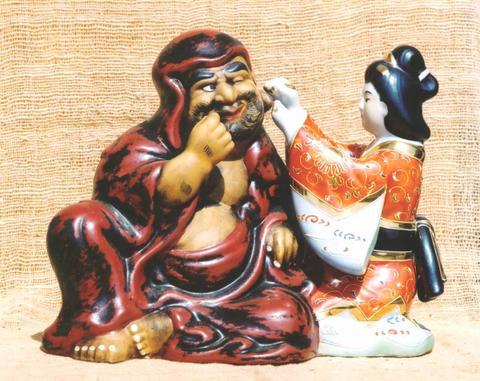
More about this in my story of Kutaniyaki and Daruma
:::::::::::::::::::::::::::::::::::::::::::::::::::::::::::::::::::::::::::::::::::::::::::::::::::
Things found on the Way
Nice Gallery of Hanga with Folk Art Themes, one of them a Lady Daruma Doll
http://www.showa-corp.jp/toshakan/gallery/ita/ita07.html
〔1〕 三春の木馬(福島県) http://www.showa-corp.jp/toshakan/gallery/ita/ita01.html
〔2〕 花巻の鶏(岩手県) Chicken from Iwate
〔3〕 加茂の猫(新潟県) Cat from Niigata
〔4〕 富山の獅子頭(富山県) Lion Heads from Fukuyama
〔5〕 古賀の子守り(長崎県) Children from Nagasaki
〔6〕 三条の鳩持ち(新潟県) Dove from Niigata
〔7〕 竹田の女達磨(大分県) Lady Daruma from Oita

〔8〕 鳥取のきびから姉さま(鳥取県) Tottori
http://www.showa-corp.jp/toshakan/gallery/ita/ita01.html
:::::::::::::::::::::::::::::::::::::::::::::::::::::::::::::::::::::::::::::::::::::::::::::::::::::
Ishikawa Toyonobu (1711–85)
Courtesan Dancing to Daruma’s Accompaniment

Among the most popular subjects in mitate-e are pairings of courtesans with religious figures such as Daruma (Bodhidharma in Chinese), the Indian monk who transmitted Chan (Zen in Japanese) Buddhism to China, as seen at the top of this post. The juxtaposition of this ascetic with a courtesan of the pleasure quarters humorously critiqued religion as well as the culture of the ruling samurai class who boasted of their dedication to Zen. It also underscores the core values of the genre known as ukiyo-e (or ‘pictures of the floating world’), to which this painting belongs. The word ukiyo (‘transitory world’) was derived from Buddhism, referring to the ephemeral nature of this world. By replacing the character for uki 憂き (meaning ‘transitory’) with a homonym 浮meaning ‘floating,’ a profound Buddhist idea was turned upside down to express the attitude of joie de vivre characteristic of the pleasure quarters.
Zen Buddhism teaches that anyone is able to reach enlightenment through simple, banal activities such as chopping wood or taking naps. Here, the courtesan’s knowledge of the ‘floating world’ (ukiyo 浮世) is compared to Daruma’s enlightened realization of the ‘evanescence of the world’ (ukiyo 憂き世). It also suggests that one can find enlightenment, or release, in the carnal activities of the pleasure quarters. Pious Daruma playing the shamisen, a popular musical instrument among courtesans and geisha, further increases the wry humor.
The poem accompanying the image is by Old Priest Rinsen in the Jōkyō era (1684–88).
It reads:
Why have you come from the west?
Don’t ask and cause me to regret it.
In playing the shamisen, the bridges do not count.
The heart alone sings:
Is it the plectrum or the strings
Which makes the music?
Tr. Kuniko Brown
source : pacificasiamuseum.wordpress.com
:::::::::::::::::::::::::::::::::::::::::::::::::::::::::::::::::::::::::::::::::::::::::::::::::::::
Nighthawks, yotaka 夜鷹
The cheapest prostitutes, on small boats by the rivers and walking the streets with a straw mat, were called "nighthawks (night hawks)" yotaka or streetwalkers (sooka).
The word "yotaka" refers usually to these girls, not to the bird.
Since the Showa period, nighthawk is used for 宵っ張り yoitsupari, a night owl or a
night person.
"yotaka soba 夜鷹蕎麦" means a buckwheat stall for midnight customers.
. Edo Yatai 江戸屋台 Food stalls in Edo .
The most famous three ones were for
Sushi, Tenpura and Soba buckwheat noodles.
Oumayagashi by Hiroshige
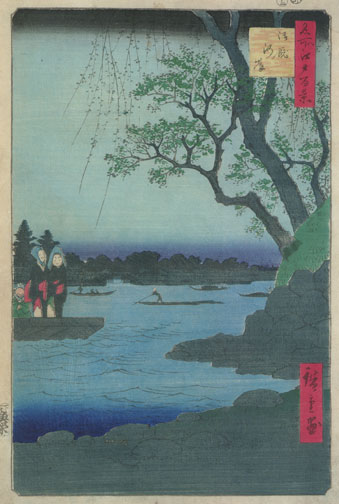
It is a murky winter night as the Oumayagashi ferry approaches its landing on the west bank of the Sumida just north of the Asakusa rice granaries of the bakufu. Against this somber background, the white faces, red sashes and blue head-towels of the two women in the bow of the ferry stand out in bright relief.
These are yotaka, "night hawks," the lowest class of street prostitutes. They are accompanied by their gyu, perhaps a father or brother, who served as bodyguard and tout. This scene is the closest Hiroshige ever gets to depicting the harsh realities of lower-class life in Edo, and he does so in a way calculated not to offend.
© Robyn Buntin of Honolulu
:::::::::::::::::::::::::::::::::::::::::::::::::::::::::::::::::::::::::::::::::::::::::::::::::::::
yuujo 遊女 "woman to play with", cheap prostitutes
- - - - - Yosa Buson - - - - -
ほととぎす歌よむ遊女聞ゆなる
hototogisu uta yomu yuujo kikoyu naru
hototogisu
I hear a curtesan
composing poetry
Tr. Crowley
..........................................................................
Buson had spent some time in Sanuki, Shikoku in 1766 and on the way back visited the famous port town of Murotsu, Muro no Tsu 室津 in Harima no Kuni, now Hyogo prefecture.
The town was famous for its prostitutes on boats.

source and more photos : kamnavi.jp/log/ugayuujo.htm
梅咲て帯買室の遊女かな
ume saite obi kau muro no yuujo kana
plums are blossoming
and the prostitutes of Muro
buy new sashes . . .
Tr. Gabi Greve
朝霜や室の揚屋の納豆汁
asagiri ya muro no ageya no natto jiru
morning mist -
the Natto soup at the brothel
of Muro
Tr. Gabi Greve

Murotsu Kaido 室津街道 the Murotsu Road
source : murotsukaidou
ageya 揚屋 House of assignation, where patrons made appointments with courtesans in the pleasure quarters, precursor of the geisha teahouse.
MORE vocabulary about the Geisha world:
source : www.eurekaencyclopedia.com
..........................................................................
若竹や橋本の遊女ありやなしや
wakatake ya hashimoto no yuujo ariya nashi

source : ameblo.jp/poire-w-pere/entry
Buson - Wakatake ”若竹図”
At Kyoto Kawasaki there was a place famous for bamboo called HASHIMOTO, and many boats passed the river Yodogawa, where famous courtesans waited for customers on the left bank ..
But the HASHIMOTO of Buson might not be there, rather coming from a Noh theater play 江口のはしもと Eguchi no Hashimoto.
Buson might have been wondering if even nowadays famous geisha would be there near the Hachiman shrine of Hashimoto.
Even the famous monk Saigyo had been visiting this place and wrote waka poems about it.
Wakatake bamboo might also have reminded Buson of his own mother.
- quote -
Eguchi (江口) is a Noh play of the third category, written by Zeami around a fragment (the harlot's sermon) by Kanami. The play combines two legends, one related of the holy man Shōkū (concerning the identity of the harlot of Mura with the bodhisattva Fugen) and the other related of the monk Saigyō (the admonishment of the harlot of Eguchi).
A travelling monk arrives by night at the port of Eguchi. Seeing a cairn, he enquires about its origin and is told that it commemorates the Lady of Eguchi, a former harlot who was considered to be a manifestation of the bodhisattva Fugen. (During a rainstorm, the 12th-century monk Saigyō asked for shelter at her house, but was refused entry. He reproached her with an impromptu poem, to which she made an effective reply, hinging on a Buddhist interpretation of the words "a moment's refuge"; she then admitted him and engaged in a long conversation.)
The travelling monk thoughtfully recites Saigyō's poem to himself, and is overheard by a passing woman, who asks him to follow it with the harlot's reply. She tells the monk not to believe the gossip about her; when she vanishes they realise that she is, in fact, the ghost of the harlot of Eguchi.
A villager then tells them the story of Shōkū, who longed to worship the living Fugen, and was directed in a dream to seek the Lady of Eguchi.
Fascinated, the monk begins to repeat a sutra by her grave. A boat, brightly moonlit, appears, bearing the Lady along with two singing girls. They sing of the unhappiness of mortals ensnared in illusion and condemned to be reborn. In conclusion, they remind the monk that "all things are a moment's refuge"; the Lady reveals her identity as Fugen, and ascends into the clouds.
© More in the WIKIPEDIA !
young bamboo -
will the courtesans still be there
at Hashimoto ?
Tr. Gabi Greve
- Chris Drake wrote:
Eguchi is on the west bank of the Yodo River just north of Osaka and far downstream from Hashimoto, which is on the east bank of the river not far south of Kyoto. Buson elsewhere mentions the 'courtesans in Eguchi and Hashimoto,' i.e., the courtesans at two spots where there used to be elegant women singers and dancers who sometimes also took male customers. Buson is referring to Eguchi no Kimi, who appears in the noh play 'Eguchi' as well as to other famous women performers who danced and sang along the Yodo River centuries before. In this hokku, he is praising the beautiful young bamboos in Hashimoto in his day, and deep inside one grove of young bamboos there he sees houses he knows to be the houses where courtesans work. Of course he knows that the Hashimoto courtesans of his day aren't well educated and can't, like the famous Eguchi no Kimi, exchange waka poems with the famous poet-monk Saigyo, or refuse visitors, as Eguchi no Kimi refused Saigyo. He knows that the ancient courtesans in Hashimoto are gone forever, and that the present women in this house are probably just sex workers, but he wonders if there could possibly, as in a dream, be the real, classical women performers of Hashimoto inside the houses. His question is probably rhetorical: of course it is impossible, and yet, and yet.... So the tone seems to be elegiac.
He is half-seeing a vision of ancient houses. The bamboos grow equally beautifully year after year, but the human world is different, and the elegant, educated, artistic performers of Hashimoto (and Eguchi downstream) are gone forever. The bamboos suggest time passing, returning every year and continually fresh and alive as a species, so they are both beautiful and cruel, since time causes humans to die and disappear. The bamboos might also suggest that the modern young women in the houses are not allowed to grow freely and become naturally beautiful like the bamboos because of the poverty that forces them to be sex workers.
Buson has a nice haiga of this hokku that shows several thin bamboos standing in front of two or possibly three houses.
(see above Wakatake)
The last line of the hokku refers to a waka by Narihira in the 9th episode of 'Ise Tales' (Ise-monogatari).
There the protagonist, exiled to the east, sees a bird on the Sumida River and asks the bird whether the woman he loves who lives back in the capital (and whose clandestine love for him seems to be the reason for his exile) is still alive or not. Buson, however, uses only one 'ya.' This allusion suggests Buson is asking whether the famous women performers of Hashimoto are still alive or not. Unfortunately the answer is surely -- except in the time of visions and noh plays -- no....) Buson may see himself as a modern Narihira or Saigyo, and he seems to wish a visionary woman would appear from out of the distant past -- or the other world. The bamboos are a moving border between this world and the other.
- source : Chris Drake , facebook 2017 -
. Buson travelling the river Yodogawa 淀川 - Fushimi .
- - - - -
. Fugen Bosatsu 普賢菩薩 Samantabhadra .
河内女の宿に居ぬ日やきじの声
Kawachi-me no yado ni inu hi ya kiji no koe
the Kawachi weaver girls
are not at home -
voice of the pheasants
Tr. Gabi Greve
Kawachime refers to the girls who had to weave cotton, since the Kawachi-plain 河内平野 (now Osaka plain) was famous for cotton plants.
the "voice of a pheasant" ould be a man calling for his girl . . .
. WKD : Cotton from Kawachi .
..........................................................................
抱籠やひと夜ふしみのさゝめごと
dakikago ya hitoyo fushimi no sasamegoto
Sleep with "daki kago"!
As with a one-night harlot at Fushimi
Exchanging lovers' talks.
- Comment by Shoji Kumano
. "hug basket" dakikago 抱籠 .
kigo for all summer
. Yosa Buson 与謝蕪村 in Edo .
sasamegoto ささめごと promises and secrets exchanged by lovers
- and
“Murmured Conversations”
Muromachi-period (1333−1568) poetic treatise on renga (linked verse) written by the Tendai monk Shinkei.
春雨や同車の君がさざめ言
. harusame ya doosha no kimi ga sasamegoto .
or
yuku haru ya doosha no kimi no sasame goto
:::::::::::::::::::::::::::::::::::::::::::::::::::::::::::::::::::::::::::::::::::::::::::::::::::::
keisei, 傾城, another expression for a lady of the night.
And some HAIKU
tama-arare yotaka wa tsuki ni kaerumeri
hailstones –
in moonlight, the nighthawks
come home
Uejima Onitsura (1660-1738)
(Tr. Michael Haldane)
かはほりに夜ほちもそろりそろり哉
kawahori ni yahochi mo sorori-sorori kana
like the bats
the nighthawk too
slow and sure
Kobayashi Issa
(Tr. David Lanoue)
:::::::::::::::::::::::::::::::::::::::::::::::::::::::::::::::::::::::::::::::::::::::::::::::::::::::

Utagawa Kuniyoshi
igned: Ichiyūsai Kuniyoshi ga 一勇斎国芳画
"Zazenmame" from the series Daruma's buffonery (Doke Daruma Asobi)
Actors caricatured as Daruma (rare).
After the imposition of a ban on actor prints in 1842, Kuniyoshi produced numerous humorous designs with thinly disguised actors’ portraits. In this series, well known actors are portrayed as Daruma, without any mention of their names. This series is listed as number 191 in Kuniyoshi by Basil William Robinson (Victoria and Albert Museum, London, 1961).
According to the Kuniyoshi Project this publisher is Hori Masa. There are other prints in this series which carry a different publisher's seal.
Marks says that this publisher's seal only appeared in 1849.
Actors Ichimura Uzaemon XII (right), Ichikawa Danjūrō VIII (center) and Onoe Kikujirō II (left)
- source : woodblockprints.org
. Utagawa Kuniyoshi 歌川国芳 .
:::::::::::::::::::::::::::::::::::::::::::::::::::::::::::::::::::::::::::::::::::::::::::::::::::::::
More ONNA DARUMA in my photo album
Scroll: Daruma with Lady
"Onna Daruma" by Toba Hiromaru 鳥羽広丸
"Onna Daruma" by Yamahigashi Kyooden 山東京伝
. senryu about Yoshiwara 吉原 pleasure quarters in Edo .
. Yoshiwara Nana Fushigi 吉原七不思議
The Seven Wonders of Yoshiwara .
. - - - Welcome to Edo 江戸 ! .
:::::::::::::::::::::::::::::::::::::::::::::::::::::::::::::::::::::::::::::::::::::::::::::::::::::
[ . BACK to DARUMA MUSEUM TOP . ]
[ . BACK to WORLDKIGO . TOP . ]
- #onnadaruma #courtesandaruma #femaledaruma -
:::::::::::::::::::::::::::::::::::::::::::::::::::::::::::::::::::::::::::::::::::::::::::::::::::::



 Posts
Posts



30 comments:
Iwabuchi Onna-Daruma, Daruma as a Courtesan
... ... ... 岩淵の女達磨
Utagawa Kunisada (1786-1864)
The background showing a landscape between stations Kanbara and Yoshiwara on the Tôkaidô road,
kanbara is my native town and Iwabuchi is my wife's town.
That is promblem !!
sakuo.
.
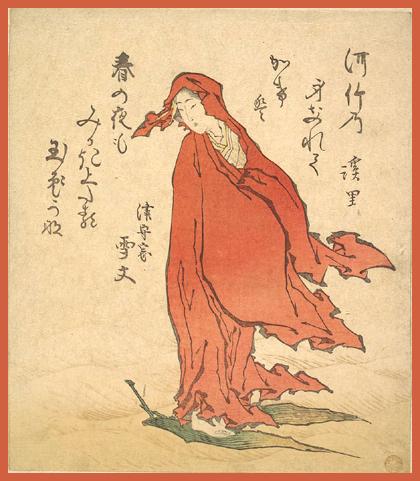
Courtesan Daruma on a reed
Woodblock by Suzuki Harunobu (1725-1770)
::::::::::::::::::::::::::::::::::::::::::::::::::::::::::::::::::::::
From Larry:
Yesterday, I visited an exhibit of Japanese art at the Asia Society
in New York City, itled: "Designed for Pleasure: The World of Edo Japan in Prints and Paintings, 1680-1860."
Thanks to Gabi's work in her darumasan blogspot entry on daruma-and-courtesans, I was well-prepared to appreciate seeing several prints and paintings on this subject in the exhibit.
The first two prints I encountered on this subject were by the artist
Okumura Masanobu (1686-1764). He is credited with introducing several innovations into ukiyo-e, among them being new formats, compositional techniques, coloring methods, and subject matter, according to an essay by Sarah E. Thompson in the exhibit catalog.
The two prints of his in the exhibit on the subject of daruma-and-courtesans show Daruma sitting on a leaf being poled across the
Yantze River by a courtesan, or courtesans.
Ms. Thompson refers to this combination of "at least two completely different subjects, often drawing from the high culture and the popular culture respectively," as "'mitate' (or 'mitate-e', 'mitate pictures,' to distinguish graphic uses of the technique from written ones)." Ms. Thompson says that 'mitate' describes Masanobu's "extensive use of... witty literary allusions and parodies...". She calls the combining of Daruma with courtesans, originated by Hanabusa Itchoo (1652-1724),h "a visual joke."
Later in the exhibit, there is another example of daruma-and-
courtesan, in a hanging scroll painted for a private commission by Hokusai's assistant, Katsushika Hokuun (active 1804-44). In an essay by John T. Carpenter, he says of this painted scroll:
[Hokuun] paired a courtesan with Bodhidharma (J. Daruma) in red
monochrome in frontal pose with a conspicuously priapic contour. His
companion holds an unrolled love letter and coyly raises her sleeve
to her lips. In Edo parlance, courtesans were sometimes
called 'daruma' after the roly-poly dolls with Daruma face and torso that recall the legend of the master's loss of his legs during nine years of meditation. The idea was that a prostitute, after rolling around with a client, bounces up quickly just like a daruma doll...
The racy poem ['kyooka'--written on the hanging scroll above the
figures] says that Bodhidharma not only lost his legs, he lost
his 'ichimotsu', slang for his penis. 'Shin-kusaru' is both "my ass has decomposed" and slang for knowing another person's intimate
thoughts:
kimi o omou
hoka ni ichimotsu mo
naki ware o
shiri kusaru koso
urami narikeru
[signed] Unkin sekijoo gesaku
As I meditate on nothing
other than you, I'm ashamed
that you know my real mind.
Alas, not only have I lost my prick
but my ass has rotted away.
Playfully composed by Unkin at a party
...Unkin is the pen name of Kamo no Suetaka (1752-1842), another
prominent scholar in the National Learning movement who was also
active in the poetry world. [end of exerpt]
So, thanks again, Gabi!
Larry
beautiful courtesan--
new clothes for her hometown's
Buddha
keisei ya zaisho no mida e kinu kubari
傾城や在所のみだへ衣配
by Issa, 1825
The lady is a courtesan (keisei) dressed in a fine kimono. This haiku alludes to the Twelfth Month custom of providing gifts of new clothes, usually for one's relatives.
Here, the courtesan piously offers such a gift to the statue of Amida Buddha in her home village.
My translation could be more literal: "beautiful courtesan--/ new clothes for her hometown's/ Amida," but I feel that "Buddha" is clearer for most English readers. Ending with "Amida Buddha" would make the haiku too long, I think.
Tr. David Lanoue
http://cat.xula.edu/issa/
DIARIES OF COURT LADIES OF OLD JAPAN
TRANSLATED BY
ANNIE SHEPLEY OMORI
AND
KOCHI DOI
Professor in the Imperial University, Tokio
WITH AN INTRODUCTION BY
AMY LOWELL
And with Illustrations
COPYRIGHT, 1920, BY HOUGHTON MIFFLIN COMPANY
http://digital.library.upenn.edu/women/omori/court/court.html
遊女めが見てけっかるぞ暑い舟
yuujo me ga mite kekkaru zo atsui fune
the whores
are looking me over...
from their boat in the heat
Jean Cholley explains that prostitutes operated on boats on the west bank of Sumida River in Edo (today's Tokyo). Their price was 32 mon: which in Issa's day would buy three bowls of rice;
En village de miséreux: Choix de poèmes de Kobayashi Issa (Paris: Gallimard, 1996) 243, note 96. Kekkaru is an old verb with the same meaning as iru ("to be"); Kogo dai jiten (Shogakukan 1983) 565.
Kobayashi Issa
(Tr. David Lanoue)
.
frost-killed grass--
the little beauty
scrapes soot from a kettle
shimogare ya nabe no sumi kaku ko keisei
.霜がれや鍋の炭かく小傾城
by Issa, 1821
Ko keisei can mean "little beauty," "little courtesan," or "little prostitute."
In his translation, Makoto Ueda assumes the third meaning; Dew on the Grass: The Life and Poetry of Kobayashi Issa (Leiden/Boston: Brill, 2004) 137.
Tr. David Lanoue
.
木枯や二十四文の遊女小屋
kogarashi ya nijuu shimon no yuujogoya
winter wind--
a twenty-four cent
whorehouse
Kobayashi Issa 小林一茶
Charging just 24 mon, the price of about two bowls of rice in Issa's day, the women in the little shack are the lowest grade of prostitute.
Tr. David Lanoue
.
Mitate-e metaphors in Japanese art
Pacific Asia Museum
Our current exhibition Focus on the Subject: The Art of the Harari Collection is full of fun details to explore. One particularly humorous section examines mitate-e, which literally means “look and compare.” This is a category of Japanese art that uses metaphorical images that juxtaposes historical and contemporary events and figures, often fusing the religious with the vulgar, the high with the low, added layers of meanings that could be playful, critical or ironical references enjoyed by the educated classes.
Mitate-e became popular in the Edo period when urban culture blossomed. As the Tokugawa shogunate secured relative peace, the newly established capital Edo (today Tokyo) grew rapidly in population and economic status. The merchant class accumulated wealth but their relatively low social status limited their participation in public affairs. As a result, they looked for outlets in various forms of entertainment, and embraced mitate-e, which allowed the indirect critique of current events and élite culture. The inclusion of witty prose or poems next to images heightened the complex allusions embedded in mitate-e. Text could also nuance or disguise the interpretation, further stimulating the viewer or confusing the authorities who regulated mass-produced images.
continued
Mitate-e metaphors in Japanese art
Pacific Asia Museum
Among the most popular subjects in mitate-e are pairings of courtesans with religious figures such as Daruma (Bodhidharma in Chinese), the Indian monk who transmitted Chan (Zen in Japanese) Buddhism to China, as seen at the top of this post. The juxtaposition of this ascetic with a courtesan of the pleasure quarters humorously critiqued religion as well as the culture of the ruling samurai class who boasted of their dedication to Zen. It also underscores the core values of the genre known as ukiyo-e (or ‘pictures of the floating world’), to which this painting belongs. The word ukiyo (‘transitory world’) was derived from Buddhism, referring to the ephemeral nature of this world. By replacing the character for uki 憂き (meaning ‘transitory’) with a homonym 浮meaning ‘floating,’ a profound Buddhist idea was turned upside down to express the attitude of joie de vivre characteristic of the pleasure quarters.
Zen Buddhism teaches that anyone is able to reach enlightenment through simple, banal activities such as chopping wood or taking naps. Here, the courtesan’s knowledge of the ‘floating world’ (ukiyo 浮世) is compared to Daruma’s enlightened realization of the ‘evanescence of the world’ (ukiyo 憂き世). It also suggests that one can find enlightenment, or release, in the carnal activities of the pleasure quarters. Pious Daruma playing the shamisen, a popular musical instrument among courtesans and geisha, further increases the wry humor.
The poem accompanying the image is by Old Priest Rinsen in the Jōkyō era (1684–88). It reads:
Why have you come from the west?
Don’t ask and cause me to regret it.
In playing the shamisen, the bridges do not count.
The heart alone sings:
Is it the plectrum or the strings
Which makes the music?
(Translation by Kuniko Brown)
http://pacificasiamuseum.wordpress.com/2013/07/11/mitate-e-metaphors-in-japanese-art/
Matsuo Basho at Ichiburi
一家に遊女もねたり萩と月
hitotsuya ni yuujo mo netari hagi to tsuki
in the same house
prostitutes, too, slept:
bush clover and moon
Tr. Barnhill
Fukagawa 深川 and the Tatsumi Geisha 辰巳芸者
along the Sumida River
Kobayshi Issa
吉原も壁一重也さよちどり
yoshiwara mo kabe hitoe nari sayo chidori
plovers in the night,
Yoshiwara's right there
beyond that wall!
This winter hokku is from the tenth month (November) of 1815, when Issa is making a three-month trip to see friends and students back in the city of Edo and the area around Edo. In the hokku he seems to be walking near or along the Sumida River, which runs through Edo and whose banks are inhabited by countless plovers. Also near the Sumida, on the northern outskirts of Edo, is Yoshiwara, the entertainment area where licensed sex workers were allowed to operate. Yoshiwara was slightly different from a brothel district, since what customers bought were performances of music, song, and witty conversation at elegant parties. Sometimes hokku and waka composition were also done at the parties. The women were not required to perform sex work if they could get customers to pay just to attend the party, so the sex was negotiable and not compulsory, though in practice sex work often did accompany the partying.
The glow from lights in the various entertainment houses in Yoshiwara must be visible to Issa and others walking at night near the river, and the sounds of music and songs come floating across the fields. This worries Issa, since the naive plovers don't seem to understand that Yoshiwara is a danger zone for them. Professional bird catchers constantly roam the area, catching plovers and other birds, which they put in cages and sell in the licensed quarter. The convivial plovers chatter nonchalantly and don't seem aware of what Yoshiwara is, so Issa addresses them and warns them not to go too close to Yoshiwara and to watch out for the bird catchers, who will try to cage and imprison them in the quarter, which is surrounded by a high wooden wall to keep the women entertainers inside from escaping before their contracts are up. The language of the hokku shows sympathy not only for the plovers but also for the women working in Yoshiwara, many of whom were sent there as girls by their impoverished and indebted parents. Desperate parents sometimes sold their daughters on contracts of about ten years to one of the traveling brokers who constantly crisscrossed poor farming areas near Edo.
Chris Drake
.
Yoshiwara
google for more photos
https://www.google.co.jp/search?q=%E5%90%89%E5%8E%9F+%E5%8D%B5%E5%A3%B2%E3%82%8A&source=lnms&tbm=isch&sa=X&ei=RsZVU8eUKIuElAX51YGoCQ&ved=0CAcQ_AUoAg&biw=1680&bih=881#q=%E5%90%89%E5%8E%9F+&tbm=isch&imgdii=_
.
Hirai Gonpachi 平井権八 and Komurasaki 小紫
THE LOVES OF GOMPACHI AND KOMURASAKI
Told by
. Algernon Bertram Freeman-Mitford .
- Tales of Old Japan (1871) -
.
Read their full story here.
.
tokonoma 床の間 alcove for decorations, art nook
- part of the entry about
. Interior Design - The Japanese Home .
Kobayashi Issa
夜に入れば遊女袖引く柳哉
yo ni ireba yûjo sode hiku yanagi kana
when night falls
whores tug at sleeves...
willow tree
The expression, sode hiku, literally denotes dragging one by the sleeve; metaphorically, it refers to seduction. Shinji Ogawa writes, "The willow is connotative of a red-light district." He translates yûjo sode hiku as "the prostitutes pulling the sleeves."
David Lanoue
吉原細見の図
Yoshiwara Hosomi no Zu
奴定
"Illustrated Guide to the Yoshiwara"
吉原細見記五葉松
browse our way down the streets and alleys of the Yoshiwara, see all the names of the houses & their ladies and attendants. An encyclopedia of lore.
Yoshihara Hosomi ?
吉原細見 ヨシワラ サイケン
yoshiwara saiken
discussion of facebook
https://www.facebook.com/groups/400789560054621/permalink/661043827362525/
.
http://www.wul.waseda.ac.jp/kotenseki/search.php?cndbn=%8Bg%8C%B4%8D%D7%8C%A9
.
aimai women 曖昧女(おんな).
Kappa legend 河童 ....................................................................
Once the Kappa from the bridge 宮川橋 Miyagawakyo was looking for a bride.
The Nakodo was going to be the Kappa from the bridge 二の橋 Ninobashi.
But the bride was known as a prostitute from a tea stall and the Kappa from Ninobashi was a kown Aimaiya 曖昧屋, keeping aimai women 曖昧女(おんな).
.
http://heianperiodjapan.blogspot.jp/2015/08/nakodo-matchmaker.html
aimai women 曖昧女(おんな).
Kappa legend 河童 ....................................................................
Once the Kappa from the bridge 宮川橋 Miyagawakyo was looking for a bride.
The Nakodo was going to be the Kappa from the bridge 二の橋 Ninobashi.
But the bride was known as a prostitute from a tea stall and the Kappa from Ninobashi was a kown Aimaiya 曖昧屋, keeping aimai women 曖昧女(おんな).
.
http://heianperiodjapan.blogspot.jp/2015/08/nakodo-matchmaker.html
‘Little Songs of the Geisha’ Traditional Japanese Ko-uta
translated by Liza Dalby - American anthropologist
.
A fascinating look into the world of the Geisha through the 400-year-old art of Ko-Uta, the traditional song form sung to three-stringed shamisen music. A vivid evocation of the romanticism of feudal Japan.
.
The label kouta (which roughly translates as, “little song”) has been applied to any number of popular Japanese music forms over the centuries. But these days, the word usually refers to a specific genre of shamisen music that evolved in 19th-century Edo (present-day Tokyo) from existing popular styles, particularly hauta (roughly, “short songs”). The first kouta is traditionally said to have been “Chiru wa Uki” (“Those that fall float”), composed in 1855 by “Joruri” puppet theater singer Kiyomoto Oyo (1840-1901), and by the early 20th century kouta was a lively and varied form — and a vital part of a geisha’s repertoire of light entertainment.
- - - Japan Times and amazon com.
joroo-kai Jizo 女郎買地蔵 Joro-kai Jizo buying a prostitute
at the temple 大雲寺 Daiun-Ji in 桶川宿 Okegawa town (Postal station Nr. 6 on the Nakasendo Road)
女郎買い地蔵 - This state has been put in place in 1557.
Okegawa was quite a busy postal station and had many brothels. Not only the travellers, but also locals frequented these places. Soon there was the rumor that even the Jizo statue of the temple was out there enjoying himself. So the head priest tried to solve the problem. He fixed a clamp on the back of the statue and used a chain to bind it.
Since then, the Jizo did not move any more.
To tell the truth (maybe?)
there was a young priest in the temple who went out every night . . . but got stopped when he saw his master fix the Jizo to teach him a lesson and save him.
The clamp on the back of the statue can be seen to our day.
(2 photos)
.
https://gokurakuparadies.blogspot.jp/2014/07/jizo-special-statues.html
.
ukiyo-e with courtesan poems:
http://blog.honoluluacademy.org/spotlight-on-japanese-art-the-literary-world-of-the-women-of-the-yoshiwara/
.
Kado Reiko -Edo joryuu bungaku no hakken
- 門玲子『江戸女流文学の発見』
with a brief section on waka written by prostitutes
.
Takeuchi Gengenichi 竹内玄玄一 Haika kijin dan 俳家奇人談
.
Ishikawa Gineishi 石川銀栄子 Echizen haikaishi shishi 越前俳諧史誌 (Fukui : Matsumi Bunko, 1971)
.
Taito Ward - Legends -
yuurei 幽霊 ghost
Around 1884 there lived a monk named 霊瞬 at 三縁山 Sanenzan. He frequently went to the pleasure quarters of Yoshiwara and eventually fell in love with 琴柱 Lady Kotoji. He told her about his miserable life and how all would change if he had some money to get a better job. So Kotoji gave him all her money, made him promise never to go to Yoshiwara again and committed suicide.
When he went back anyway, the ghost of Kotoji showed up and scolded him severely. Now at least he changed his easy-going way and later became a high-ranking priest.
.
https://edoflourishing.blogspot.jp/2017/07/taito-ward.html
.
https://edoflourishing.blogspot.jp/2014/01/senryu-yoshiwara.html
>
Legends to explore and Senryu to enjoy
.
kamuro 禿(かぶろ / かむろ) child attendant of a courtesan
.
https://omamorifromjapan.blogspot.jp/2017/10/kamuro-child-attendant.html
.
Tokyo, Minowa 三ノ輪 / 箕輪 Minowa district
During the Great Fire of Meireki in 1657 most of the city of Edo burned down, including the pleasure district. The new pleasure district, Yoshiwara 吉原, was close to Asakusa and thus to Minowa.
.
https://edoflourishing.blogspot.com/2018/06/minowa-district.html
.
A legend from Kanagawa 神奈川県 浦賀町 Uraga town
A craftsman fell in love with a yuujo 遊女 prostitute, but his jealous wife killed the prostitute. From that day on, her ghost came to the room every night and rustled her hair along the shooji 障子 sliding doors. Her husband became all anxious and finally went on a pilgrimage. When he wanted to get a place for the night, he was always asked "For the two of you?"
Eventually he went to the temple 龍本寺 Ryuhon-Ji and died there.
.
https://edoflourishing.blogspot.com/2020/05/shokunin-craftsmen-legends.html
.
The depressing diet of a Tokyo prostitute during Japan’s Edo period
Yoshiwara was once where men with money to burn came to entertain themselves, while this woman was eating rotten pickles, or sometimes nothing at all.
In Japanese entertainment media, the Edo period is an often romanticized part in the country’s history, and it’s not hard to see why. Lasting from 1615 to 1868, the Edo period is sandwiched between centuries of bloody civil war and the rapid industrialization and expansionist policies which put Japan on the path to the international conflicts that ultimately resulted in its defeat in World War II.
So in the popular imagination, the Edo period is frequently thought of as a peaceful interlude in which Japan was both free of internal conflict and isolated from the complications of the larger world. Sometimes, even the Edo era’s pleasure quarters are viewed through rose-colored lenses, with novels, manga, and movies centered on beautiful courtesans whose charms and insightful wisdom turn the story of her life into a colorful and lavish tapestry of the sunset of Japan’s shogunate days.
But reality wasn’t always so luxurious for the women who serviced men’s desires in Edo’s brothels, as shown in this excerpt from historical researcher Yuriko Yokoyama’s Umemoto Records, which records the meals eaten by a prostitute working in the Yoshiwara pleasure quarter of Edo (present-day Tokyo) in 1850.
https://soranews24.com/2020/12/01/the-depressing-diet-of-a-tokyo-prostitute-during-japans-edo-period/
.
Princess Daruma
Princess Daruma Dolls from Matsuyama
松山の姫達磨
.
https://darumadollmuseum.blogspot.com/2004/11/matsuyama-princess-daruma.html
.
Post a Comment