8/17/2005

Rush-Leaf Daruma (royoo)

[ . BACK to Daruma TOP . ]
:::::::::::::::::::::::::::::::::::::::::::::::::::::::::::::::::::::::::::::::::::::::::::::::::::::

Daruma on a Rush-Leaf . . on a reed
Royoo Daruma 芦葉達磨

There are many renderings of Daruma figures, but what they want to express on the inside is always the same. It is the spirit of Daruma Daishi (about 5th Cent.), the eighth generation Great Master after Shakyamuni Buddha, founder of the Zen sect. Legend says that Daruma was born the third prince in a South Indian kingdom. He was of a sharp mind already as a child and followed the Great Master Prajnaatara, where he studied Buddhism intensly and carried on his tradition. He then took off to China to preach Buddhism, taking the sea road to South China.

He was invited by Emperor Wu and expounded his wisdom for him. But the emperor did not understand the preachings of Daruma, so Daruma took off again, crossing the Yangtse River to the east and ended up in the Shaolin Temple near Loyang. He stood on some reeds when crossing the river, which leads to the famous iconographic rendering of "Rush-leaf Daruma" (royoo Daruma 芦葉達磨).

:::::::::::::::::::::::::::::::::::::::::::::::::::::::::::::::::::::::::::::::::::::::::::::::::::::


正阿弥勝義作 芦葉達磨像
©(林原美術館蔵)

by Shooami Katsuyoshi
http://www.libnet.pref.okayama.jp/mmhp/kyodo/person/syouami/syouami.htm

Shooami was born in Tsuyama, a city close to my present home in Japan.

:::::::::::::::::::::::::::::::::::::::::::::::::::::::::::::::::::::::::::::::::::::::::::::::::::::

Nantembo (1839-1925)
Daruma crossing the Yangzi river on a rush leaf


..... Although the emperor was gracious, he did not pretend to grasp Bodhidharma's meaning, and the monk decided to travel north, crossing the Yangtze River on a rush leaf (J. royô) and went to the northern kingdom of Wei where he spent nine years meditating in the Shaolin monastery.

Bodhidharma's mysterious crossing the Yangzi River on a rush leaf has first been mentioned in the 13th century: The Wudeng huiyuan, edited in 1252 by Dachuan Puji (1179-1253), the Wujia zhangzong zan, compiled two years later by Xisou Shaotan (d. 1279) and the Shishi tongjian, in 1270 by Ben Jue state Bodhidharma's breaking off a rush leaf and crossing the Yangzi river. But these sources do not indicate the use of the rush leaf as a vehicle.

This aspect probably was introduced later to compensate Bodhidharma's fruitless visit at the emperors court. Earlier sources as the Jingde chuandeng lu (J. Kidoroku) compiled by Xutang Zhiyu (J. Kido Chigu, 1185-1269), in the years 1004-07 or the Chuanfa zhengzong ji, 1060 do not mention any rush leaf at all. (Brinker/Kanazawa 1993, 208).

Zen practice has had little use for miraculous deeds, stressing instead the enlightenment of the everyday world. The Chinese character that originally meant both reed boat and reed lost its first meaning over the course of time. This inspired the idea that Daruma had crossed on a reed rather than in a reed boat. (Addiss 1989, 57.)

© Bachmann Eckenstein Art & Antiques
http://www.art-antiques.ch/nantembo/paintings/02.html

:::::::::::::::::::::::::::::::::::::::::::::::::::::::::::::::::::::::::::::::::::::::::::::::::::::

Daruma riding leaves and crossing the sea to Japan


Attr. To Hokusai or Oi, Hokusai's daughter. Most probably Oi.

© The Art of Japan, R. Waldmann

:::::::::::::::::::::::::::::::::::::::::::::::::::::::::::::::::::::::::::::::::::::::::::::::::::::

By Miyamoto Musashi
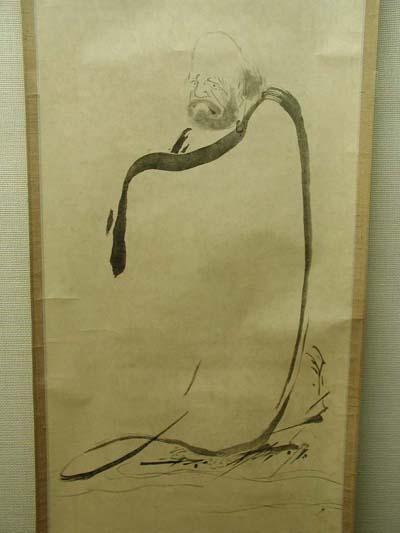


http://www.webtsc.com/musashi/


芦葉達磨(ろようだるま)・浮鴨図(うきがもず)
宮本武蔵筆
http://www.city.kumamoto.kumamoto.jp/shiseidayori/04/01/syokubutsu/

:::::::::::::::::::::::::::::::::::::::::::::::::::::::::::::::::::::::::::::::::::::::::::::::::::::

In a Chinese style, with hat and staff


禅祖達磨大師が芦の葉に乗り黄河を越える有名な伝説の場面。古来中国や我国の著名な禅僧諸氏が競って書いたので、数多くの水墨画がある。
[落款] 甲子元春釋紹明並題(印)
寸法 (本紙)縦98×横42.5cm (軸寸)縦172×横52cm
© 有限会社アンダーアート
http://www.anderart.jp/page_thumb427.htm

:::::::::::::::::::::::::::::::::::::::::::::::::::::::::::::::::::::::::::::::::::::::::::::::::::::

Daruma on a Reed (Rozan Eko)


© by Jacqueline McAbery

http://www.createart.com/darumaonareed.htm

:::::::::::::::::::::::::::::::::::::::::::::::::::::::::::::::::::::::::::::::::::::::::::::::::::::

Look at more pictures here:

Paintings by Hakuin Zenji 白隠の禅画と墨蹟
The Ryu'un-ji Collection

http://iriz.hanazono.ac.jp/hakuin/rekihaku/


蘆葉達磨大師也
Great Teacher Bodhidharma riding a reed.

The title and inscription are based on the legend that Bodhidharma, after his unsuccessful meeting with Emperor Wu, crossed the Yangze River on a reed as he made his way north toward the country of Wei.

是でも蘆葉達磨大師也
The picture and inscription are a pairing of two genres of Daruma portraits: Daruma on a Reed (芦葉達磨 Royo Daruma) ), explained above, and One Shoe Daruma (隻履達磨 Sekiri Daruma, based on the legend that Bodhidharma after his death and burial, was seen walking through the mountains on his way back to India, wearing a single shoe. When Bodhidharma’s grave was later examined, it was found to be empty except for the Patriarch’s other shoe). These stories may be regarded as expressive of the time- and space-transcending nature of the buddhadharma.

。。。。。。。。。。。。。。。。。。。。。。。。。。。。。。。


Cleaveland Museum
The Zen Patriarch Daruma on a Reed

Bodhidharma (Daruma in Japanese) is the founder of the Zen school of Buddhism. He is usually represented as a bearded figure whose dark-skinned appearance refers to his Indian ancestry. His scowling facial expression not only signifies the determination with which he pursues religious enlightenment, but also discourages followers who are not similarly motivated.
http://www.clevelandart.org/explore/artistwork.asp?artistLetter=S&recNo=85&woRecNo=0


:::::::::::::::::::::::::::::::::::::::::::::::::::::::::::::::::::::::::::::::::::::::::::::::::::::


Daruma riding leaves and crossing the sea to Japan


Attributed to Hokusai or his daughter, Oi


::::::::::::::::::::::::::::::::::::::::::::::::::::::::::::::::::::::::::::::::::::::::::::::::::::: 


Geisha as Daruma Crossing the Sea
Suzuki Harunobu


- - - - - and even more direct


Ippitsusai Bunchoo 一筆斎文調 Buncho (ca. 1760–1794)

:::::::::::::::::::::::::::::::::::::::::::::::::::::::::::::::::::::::::::::::::::::::::::::::::::::


Daruma Crossing the Yangtze River
WHAT DOES THE REED SYMBOLIZE?
From a conventional viewpoint, it might symbolize the miraculous feat of crossing a mighty river while balanced on a tiny reed, or it might refer to "crossing to the other shore," or, as author John Stevens suggests, it could symbolize smooth sailing over the turbulent waters of samsara (cycle of suffering). But a growing number of art scholars think otherwise. Charles Lachman for instance, says the first textual reference to the river crossing [on a reed] dates from 1108, that the theme did not become widespread until the 13th century, and that the rushleaf [reed] motif should not be considered a biographical narrative, as heretofore believed. Scholar Bernard Faure suggests a radically new interpretation. Since Daruma was, by the 16th century, considered a protector against smallpox and other epidemic diseases, Faure believes the reed was used by the Japanese to establish Daruma's credentials as an epidemic deity. Writes Faure: "Epidemic deities were related to water, and often came from the West, crossing large bodies of water.
source : Mark Schumacher


Daruma as a Woman
By Katsushika Hokusai 葛飾北斎 (1760-1849).
Daruma Crossing the River on a Reed.
By Suzuki Harunobu 鈴木晴信 (1743 - 1807).
source : Mark Schumacher

:::::::::::::::::::::::::::::::::::::::::::::::::::::::::::::::::::::::::::::::::::::::::::::::::::::


よしあしに渡り行く世や無一物
yoshiashi ni watari-yuku yo ya mu ichibutsu

this world
we pass on a rush leaf -
not one thing


Painting is here :
. Tagami Kikusha 田上菊舎 Poetess and Painter


::::::::::::::::::::::::::::::::::::::::::::::::::::::::::::::::::::::::::::::::::::::::::::::::::::: 

[ . BACK to WORLDKIGO . TOP . ]
[ . BACK to DARUMA MUSEUM TOP . ]

:::::::::::::::::::::::::::::::::::::::::::::::::::::::::::::::::::::::::::::::::::::::::::::::::::::

7/19/2005

Lanterns (choochin)

[ . BACK to Worldkigo TOP . ]
::::::::::::::::::::::::::::::::::::::::::::::::::::::::::::::::::::::::::::::::::::::::::::::::::::: 
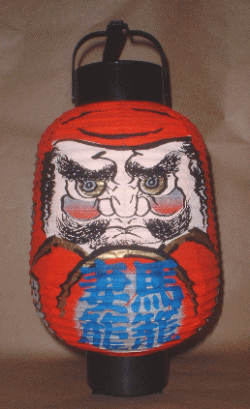
Lanterns with Daruma, Daruma Choochin
だるま提灯
choochin 提灯 / 提燈 / チョウチン Chochin, Lantern, Lanterne


This one is from Hakone.

This type of lantern with Daruma is a common souvenir found in many tourist areas. I have some from Kamakura, Miyajima and other famous places.


. bake-choochin 化け提灯 Bake-Chochin, Monster Lantern .
Chōchin-obake 提灯お化け, "paper lantern ghost"

:::::::::::::::::::::::::::::::::::::::::::::::::::::::::::::::::::::::::::::::::::::::::::::::::::::

On this page, you can click on the arrow and see the whole process of making a paper lantern. It takes a while to upload.

だるま提灯の作成行程
提灯が仕上がるまでの作業工程を説明しています。
骨組みの作成から紙貼りまでを紹介しています。
http://www14.plala.or.jp/chouchin/koutei/koutei.htm


The bamboo grid is made either of one long bamboo spiral, which breakes quite easily but is cheap to make.
Or circles of different size are adjusted around a woode frame and then sewn together with a string. They are covered with paper and the wooden frame form taken out. Then each fold is carefully made with the fingers.
This type is more expensive and called Lantern from Kyoto (kyoo choochin 京提灯)
. . . CLICK here for kyoto lantern Photos !


:::::::::::::::::::::::::::::::::::::::::::::::::::::::::::::::::::::::::::::::::::::::::::::::::::::

From a collector of lanterns, here is one from Tsumagome/Magome, Nagano.
妻籠・馬籠(長野) だるま型提灯


http://www.lcv.ne.jp/~surgek/tyoutinmagome.htm

:::::::::::::::::::::::::::::::::::::::::::::::::::::::::::::::::::::::::::::::::::::::::::::::::::::

Two modern lanterns, with electrical fixtures for indoors.


『招福だるま提灯』, 有限会社  三好商店
Good Luck Daruma From Miyoshi Store, Takamatsu, Shikoku
http://www.netwave.or.jp/~cyouchin/interior.htm


His homepage about lanterns in English
http://www.netwave.or.jp/~cyouchin/paperlantern2.htm

:::::::::::::::::::::::::::::::::::::::::::::::::::::::::::::::::::::::::::::::::::::::::::::::::::::


During the Winter Festival in Nakashibetsu, Hokkaido, lanterns of Snowman Daruma were used.
なかしべつ冬まつり


http://www.nakamap.or.jp/tiikikanko/kanko/fuyumaturi/27th.htm

:::::::::::::::::::::::::::::::::::::::::::::::::::::::::::::::::::::::::::::::::::::::::::::::::::::

During the winter festival of Takasaki town, the town of origin of the modern Daruma dolls, there are also Daruma lanterns made every year by the children.
町の通りの街灯にも子供たちが作っただるま提灯が飾られ、祭囃子の練習も始まっています。


http://www.pref.gunma.jp/g/02/nigiwai/genki-news-15.htm

:::::::::::::::::::::::::::::::::::::::::::::::::::::::::::::::::::::::::::::::::::::::::::::::::::::

Here is a Japanese Daruma Lantern in the city of Seoul, Korea.
http://www.pusannavi.com/daynews/daily_photo.html?id=234

I also found some simple lanterns, made in China, for many modern events in Japan.

In the story about the Blowfish (fugu, Japan) you find a lantern made out of a dead fish!

:::::::::::::::::::::::::::::::::::::::::::::::::::::::::::::::::::::::::::::::::::::::::::::::::::::


Quote from
Japanese Interiors, Paper Lanterns -- chochin

A "chochin" is a hand crafted paper lantern made of bamboo and Japanese washi paper. Well, at least it used to be. Now, of course, you can find factory-made plastic ones that look exactly like the real thing. Chochin cast a serene glow, simple and elegant.

Chochin lanterns are very common throughout Japan. Restaurants hang them near their entrance, indicating that they are open for business. They are generally less formal, and more utilitarian, than other traditional decorations like hanging scrolls.

To a western eye, they are perhaps one of the most widely recognizable Japanese decorations, next to, perhaps, woodblock prints or folding screens.

Chochin containing a candle were widely used during the Edo period (1603-1869) as a portable light source. During the Edo period the night-time was darker than it is today and people had to travel on foot. Odawara Chochin was both useful and psychologically reassuring because of the belief that it protected people against evil spirits. For these reasons, it was widely used, particularly by travelers from the beginning of the 18th century.

The Odawara chochin is perhaps the most well-known. Named after a person who was living in Odawara, now a city in Kanagawa, the prefecture just south of Tokyo, the Odawara chochin have three distinguishing features.

They are collapsible, small and light enough to fit in the bosom of a kimono.
They are durable and can be used in inclement weather.
It is believed that they are able to protect people against evil spirits, especially when constructed of materials gathered from sacred locations.
http://www.japanese-interiors.com/japanese-lanterns.htm

挑燈(ちょうちん) making chochin source : edoichiba tyoutin

:::::::::::::::::::::::::::::::::::::::::::::::::::::::::::::::::::::::::::::::::::::::::::::::::::::

"Chochin" was a kind of lantern at Japan in the olden times. At those days, "Chochin" served as a flash light when people went out at night. Japanese Lantern-"Chochin" made of a bamboo frame with paper covering. A candle burns inside. Today, "Chochin" is mainly used in festival at various Japanese towns. The design, pinted picture of Geisha makes it suitable for home decor.
http://www.existenz.co.jp/fu2.htm


About Lanterns from Odawara, Odawara Chochin
Chochin (Japanese lantern) widely used during the Edo period (1603-1869) is portable light that use candle as a light source. Japanese paper is applied to a spiral-shaped coil of finely split bamboo, and rings are fitted to the top and bottom of the Chochin so it can be collapsed and folded flat.
http://web-japan.org/atlas/crafts/cra10.html

CLICK for more photos
Odawara Lantern

In the pun-language of the Yoshiwara pleasure quarters, this was also an expression for an old man's penis.

Odawara choochin 小田原提灯 

. Regional Folk Craft from Japan .


:::::::::::::::::::::::::::::::::::::::::::::::::::::::::::::::::::::::::::::::::::::::::::::::::::::

Big Lantern Festival . Oochoochin Matsuri
at Suwa Shrine and other places
大提灯(おおちょうちん)諏訪神社
. . . CLICK here for Photos !


. Gifu 岐阜提灯 Gifu Chochin, Lanterns from Gifu .
With delicate hand-painted patterns. Almost like Bon Choochin.

:::::::::::::::::::::::::::::::::::::::::::::::::::::::::::::::::::::::::::::::::::::::::::::::::::::


Sanuki Choochin, Sanuki Chochin, Lanterns from Sanuki
讃岐提灯
With three layers, innermost with dragon, middle with sutras, outside with pattern


:::::::::::::::::::::::::::::::::::::::::::::::::::::::::::::::::::::::::::::::::::::::::::::::::::::::


source : blog.livedoor.jp/suntronix_fuga

kokeshi choochin こけし灯籠 lanterns in the form of wooden dolls

. kokeshi こけし wooden dolls, Kokeshi .


:::::::::::::::::::::::::::::::::::::::::::::::::::::::::::::::::::::::::::::::::::::::::::::::::::::

Lanterns for O-Bon, bonjoochin 盆提灯
(bon choochin) ぼんぢょうちん

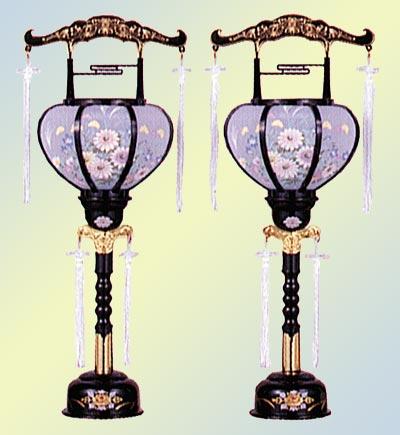
There are two types, to hang and to stand. Usually they are made to turn around and around, producing nice shadows on the paper screens of the walls and windows of a typical Japanese home.
They serve the same purpose as the fires at the entrance, to welcome and later to send off the souls of the ancestors.

Standing Lanterns

http://www.butsudanya.co.jp/shop_chochin2.html

Hanging Lanterns

http://www.butsudanya.co.jp/goods_chochin1.html

Link in Japanese
盆提灯はなぜ飾るのですか? nadonado
http://www.butsudanya.co.jp/bon_chochin5.html

Preparing bamboo lanterns for o-bon
This time they use halfcut bamboo pieces with candles to produce a natural light.
Look at the photos here:
http://pictures.nicolas.delerue.org/japan/200408_Nara_Obon/Nara_Obon_5352.html

Read more about O-Bon as a kigo for early autumn for a haiku.
Bon Festival (o-bon) お盆


盆提灯たためば熱き息をせり 
bonjoochin tatameba atsuki iki o seri

this bon lantern -
when it is closed it lets out
a hot breath


Nonaka Ryosuke (Ryoosuke) 野中亮介 (1958 - )


:::::::::::::::::::::::::::::::::::::::::::::::::::::::::::::::::::::::::::::::::::::::::::::::::::::


鳥羽(三重)from Toba, Mie prefecture

Look at many many many more :
source : kunio.raindrop.jp

:::::::::::::::::::::::::::::::::::::::::::::::::::::::::::::::::::::::::::::::::::::::::::::::::::::

. List of Edo craftsmen 江戸の職人 .


. Edo Tegaki Chochin 江戸手描提灯
Hand-Painted Paper Lanterns .

火袋提灯 hibukuro chochin (literally "fire bag lanterns")
高張提灯 takahari chochin parade lanterns with long poles

From the mid Edo Period onward, a great number of craftsmen skilled in calligraphy and brushwork resided in Edo's Asakusa district. Wholesaling systems were developed in the Meiji Era (1868-1912), this resulted in a growing division of tasks between chochin production processes and character/crest decoration processes. Even today, some Tokyo craftsmen make a living based on writing Japanese characters on finished hibukuro 火袋 ("fire bag lanterns"). The Japanese characters written on chochin are generally referred to as being in the Edo moji style (the Edo lettering style), and such chochin calligraphers also prepare senjafuda, slips of paper bearing pilgrim names that are affixed to the gates of Shinto shrines and Buddhist temples.
Although lettering is written inside an outlined area on senjafuda 千社札, chochin lack such restrictions. This leads to a slightly more free-flowing calligraphy style. Furthermore, painting family crests on chochin differs from applying them to kimono, in that the former are painted in black ink on a white background. Crests are painted in a way that facilitates visibility from a distance, and unique methods are utilized to achieve a balanced appearance.

choochinshi 提灯師 craftsman making paper lanterns


Since the dark roads of Edo at night were not always safe, the stick to hold a lantern was quite strong and could serve as a weapon in case of need.

.......................................................................


choochin hari 提灯張り gluing paper to lanterns
choochin harikae 提灯張り変え gluing new paper to lanterns


Since the paper of the folding lanters broke easily, repairing them was a good job in the towns of Edo, Osaka and Kyoto. On demand the repairmen would also paint the family crest or the name of a shop on a newly repaired lantern.

. naishoku 内職 home worker, side business in Edo .

.......................................................................

- reference : 浮世絵 提灯 Ukiyo-E -


川瀬巴水 提灯 雪の柳橋 Yuki no Yanagibashi

:::::::::::::::::::::::::::::::::::::::::::::::::::::::::::::::::::::::::::::::::::::::::::::::::::::


- ANDON 行灯 Andon lanterns of old -


. Yotaka andon matsuri 夜高行灯祭 (よたかあんどんまつり)
Yotaka andon lantern festival .

Fukuno no yotaka 福野の夜高(ふくののよたか)
observance kigo for late spring


. bonbori ぼんぼり / 雪洞 paper lantern .
- Introduction -


:::::::::::::::::::::::::::::::::::::::::::::::::::::::::::::::::::::::::::::::::::::::::::::::::::::

Akachochin Jellyfish 赤提灯クラゲ Pandea rubra


. Daruma Lantern at a Shop in Saga, Kyoto  

:::::::::::::::::::::::::::::::::::::::::::::::::::::::::::::::::::::::::::::::::::::::::::::::::::::


"Paper Lantern Seller"
Tokuriki Tomikichiro 徳力富吉郎

::::::::::::::::::::::::::::::::::::::::::::::::::::::::::::::::::::::::::::::::::::::::::::::::::::: 

. 河童 / かっぱ / カッパ - Kappa, the Water Goblin of Japan! .
- Introduction -


source : google.co.jp


::::::::::::::::::::::::::::::::::::::::::::::::::::::::::::::::::::::::::::::::::::::::::::::::::::: 

. bake-choochin 化け提灯 Bake-Chochin, Monster Lantern .
Chōchin-obake 提灯お化け, "paper lantern ghost"

[ . BACK to WORLDKIGO . TOP . ]
[ . BACK to DARUMA MUSEUM TOP . ]
- #chochin #paperlantern -
:::::::::::::::::::::::::::::::::::::::::::::::::::::::::::::::::::::::::::::::::::::::::::::::::::::

5/29/2005

Edo Daruma

[ . BACK to Daruma Museum TOP . ]
:::::::::::::::::::::::::::::::::::::::::::::::::::::::::::::::::::::::::::::::::::::::::::::::::::::
Edo Daruma 江戸だるま 江戸達磨 
Edo Papermachee Dolls, Edo Hariko 江戸張子

Red papermachee dolls, especially Daruma san, have been made in Edo as amulets to protect children from smallpox and other infectuos diseases.

半月経つと疱瘡も峠を過ぎたものとして供えた赤飯から3粒をとって紙に包み、三つ辻の角へ持っていって捨てる。この赤飯をまだ疱瘡の終わっていない子供を持つ母親が見ると持って帰って子に食べさせる。そうすると疱瘡が軽く済んだ小児にあやかることができるという。
- Papermachee Dolls 張子 / 張り子 hariko -


The Edo Daruma had been lost in time, but these days Arai Ryo
(Arai Ryoo 荒井良 )
started to revive them.


. © PHOTO : だるまさん色々


Another Daruma by Araii Ryo
Sweet Potato with a beard ...
imo hige Daruma いも髭だるま
Daruma by Araii Ryoo


Kodenmachoo Daruma 小伝馬町だるま
They have been made by the Family Iida in the suburb Kodenmacho.
Daruma holds his hands folded under the red garment to give it a beautiful rounding. Mouth in the form of letter HE へ, five strokes for a chin beard. The head rather flat, with a twig of wisteria flowers (fuji) painted in gold on the top of it.

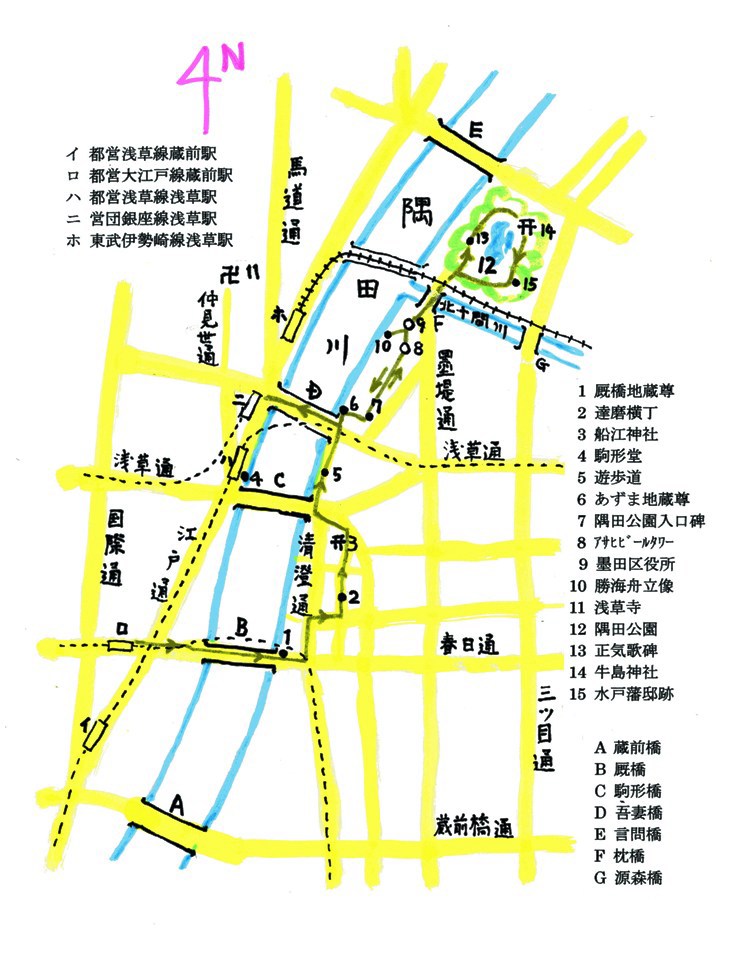
Kodenmacho : Take a tour ... External Link


Daruma Yokocho Quarters in Edo

In Edo most daruma makers lived in Honjo Daruma Yokochoo 本所達磨横丁. ブルマ横丁
They made daruma to prevent epidemics. When the business went out of patients and fire destroyed this part of town, they left for some villages outside Edo and moved to Takasaki, Koshigaya, Iwaki, and Tama (see below).
Honjo was the place where the downtown couple Chobei lived 長兵衛夫婦, now famous in a Kabuki play. In Rakugo, it is the story of Bunshichi Mottoi 文七元結.

Honjo : Take a tour ... External Link


:::::::::::::::::::::::::::::::::::::::::::::::::::::::::::::::::::::::::::::::::::::::::::::::::::


Edo Kites with Daruma
Edo Kaku Tako 江戸角凧
Edo Nishiki Tako 江戸錦凧 (和凧)
Edo Nishiki-e 江戸錦絵凧

CLICK for more Edo kites


:::::::::::::::::::::::::::::::::::::::::::::::::::::::::::::::::::::::::::::::::::::::::::::::::::


Edo Papermachee Dolls, Edo Hariko 江戸張子
Azuma hariko 東張子 papermachee dolls from Azuma

The one on the right is the Edo doll.

The one on the left is a clay doll from Nakagawa, Akita
The one in the middle is a clay doll from Nakayugawa, Fukushima


© PHOTO : bingoya
This LINK has many more dolls !


CLICK for more phots of Edo Hariko Papermachee Dolls !


:::::::::::::::::::::::::::::::::::::::::::::::::::::::::::::::::::::::::::::::::::::::::::::::::::::


CLICK for more Koshigaya photos
Koshigaya Daruma 越谷だるま 


CLICK for more Iwaki daruma
Iwaki Daruma いわきダルマ ... more photos
Iwaki Daruma 岩城だるま


CLICK for more photos
Takasaki Daruma ... 高崎だるま


CLICK for more photos
Tama Daruma, 多摩達磨 多摩だるま, 多摩ダルマ


Tako, kite 凧


Nagaya だるま長屋殺人事件 Row houses in Edo and Daruma

::::::::::::::::::::::::::::::::::::::::::::::::::::::::::::::::::::::::::::::::::::::::::::::::::::: 


Crafts and Trades of Japan,
with Doll-and-Flower Arrangements

Billie T. Chandler


. Edo craftsmen 江戸の職人 .

::::::::::::::::::::::::::::::::::::::::::::::::::::::::::::::::::::::::::::::::::::::::::::::::::::: 


. Edo, The City That Became Tokyo  


. Regional Folk Toys from Japan .


[ . BACK to WORLDKIGO . TOP . ]
[ . BACK to DARUMA MUSEUM TOP . ]

::::::::::::::::::::::::::::::::::::::::::::::::::::::::::::::::::::::::::::::::::::::::::::::::::::: 

5/21/2005

Food Offerings and Bowls

[ . BACK to Daruma Museum TOP . ]
::::::::::::::::::::::::::::::::::::::::::::::::::::::::::::::::::::::::::::::::::::::::::::::::::::: 


Food Offerings and Bowls 


Food offerings (onjiki kuyoo 飲食 供養)
Speiseopfergaben

giving alms for nuns and monks, the offerings are usually rice, soup, rice cakes (mochi 餅) or nuts and sweet cakes. Rice is usually freshly cooked or in form of rice gruel. Soup should be sweetened or contain beans. The offering in form of the fruits from trees, the nuts, is an old habit in Buddhist food offerings.

The bowls used for these offerings have their origin in the normal food containers.


Food Offering at a Temple


http://ryounji.com/guan04-08/guan08.htm

:::::::::::::::::::::::::::::::::::::::::::::::::::::::::::::::::::::::::::::::::::::::::::

Bowls for food offerings, onjiki ki 飲食器
These bowls are used to offer the food on the altar in front of a Buddha statue. In the beginning, the begging bowls where put there on a special tray. In esoteric Buddhism, two bowls where offered as a pair, usually in the same decoration as the other ritual items on the altar.
These bowls are also used in the private home altar.

Form
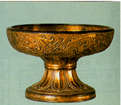
They have a high foot (takatsuki, koshidaka, koodai). They are sparcely decorated, sometimes just a band of lotus flowers or Chinese arabesques. At the bottom of the foot there can be eight lotusflowers showing toward the ground.

Material
Gold, iron or other metals.

:::::::::::::::::::::::::::::::::::::::::::::::::::::::::::::::::::::::::::::::::::::::::::

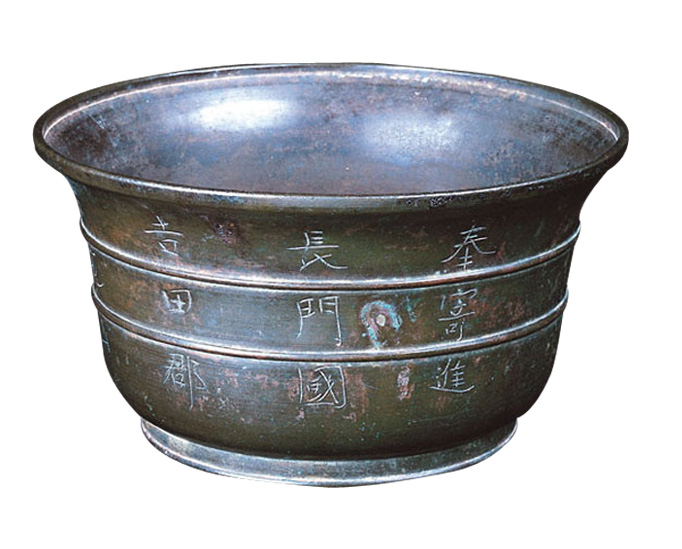
Begging Bowl (ooki, ooryooki 應量器 応量器, hatsu, Sanskrit: paatra)
Bettelschale
Also called Iron Bowl (tetsubachi, teppatsu 鉄鉢) or Buddha Bowl (buppatsu)


http://kobori.co.jp/item/642/catid/224

Their origin is in the normal bowls used by monks and nuns on their daily round of begging (takuhatsu) in India. Nowadays in Japan we can still see the monks on certain days walking through a neighbourhood, chanting their sutras in front of the door and waiting for an offering (usually money these days).

The begging bowl is a symobl of the vow of non-possession. Apart from the cloths it was the only personal belonging of a monk or pilgrim.


Form
A round bowl, the shoulder a little wider than the opening. It is carried in a kind of scarf (hatsufuku, hattai, hatsunoo), which the monk has around his shoulder during the begging walk. Sometimes the bowl is covered by a special cover (hachigai), to keep the food clean.

Material
Usually iron or simple pottery (gahatsu), usually green, red and blue. Other colors were not allowed.
According to Hamada the following materials should NOT be used for begging bowls, since they do not agree with a monk's vow of poverty: bronze, silver, wood, dry laquer (kanshitsu 乾漆) and stone.
http://www3.ocn.ne.jp/~k.hosoda/348-D_hati.htm

Here is a set of six for sale:
(see below)

http://www.mh-unit.com/designshop/japan/ouriyouki.html

.......................................................


.. .. .. .. .. .. Special types of begging bowls

Buddha Bowl (buppatsu 仏鉢)
Buddhaschale

The legend knows this:
The four heavenly gods (shitennoo) wanted to present Shakyamuni with four golden begging bowls, but he refused. He also refused to take bowls with emaille covering. Finally they brought him simpel bowls of stone which he accepted, but miraculously changed into one so that none of the gods would be offended.
He simply put the four bowls one into each other and held his hand above them, so they changed into one.


http://www.kisshodo.jp/koda-ouryouki.htm

Nowadays a begging bowl should be of a simple material. The one on the picture are of simple laquer, with spoon, chopsticks and chopstsick-holder for the daily use in a Zen temple.

Monks also use four or six bowls, one smaller then the next to hold each other, sometimes even eight bowls are used (yae mari 八重鋺). The smallest one is called "Eating Bowl" (kenshi, kenji, kunsu) in the Zen sect. They can also be used to measure rice and beans.

:::::::::::::::::::::::::::::::::::::::::::::::::::::::::::::::::::::::::::::::::::::::::::


Bowl for washing rice, busshoobachi 仏餉鉢(ぶっしょうばち)
Schale zum Reiswaschen


These bowls are often seen in Northern Japan in temples of the mountain ascetics (yamabushi).
They are used to hold offerings or to wash rice. Sometimes they are small buckets with three feet or a high foot (koodai), about 20 cm high.

この胴鉢は、仏餉鉢(ぶっしょうばち)と呼ばれるもので、神前または仏前に米飯を供える飲食器(おんじきき)の一種である。飲食器が高い脚台をつけたものであるのと異なり、低い高台(こうだい)をつけた鉢形のものを仏餉鉢と呼ぶ。賽銭を受けたり、洗米を盛ったりするものとして用いられたものである。
http://www2.coresite.ne.jp/hofubunkazai/shousai.asp?id=064

.............................................................................................


Food Offering Bowl for the home altar 仏飯器


http://www.zenbutu.com/aboutbutsugu/butugu1.htm

:::::::::::::::::::::::::::::::::::::::::::::::::::::::::::::::::::::::::::::::::::::::::::


Support for a begging bowl (hasshi 鉢支 , rindai 輪台,
Sanskrit: kattamaalaka)

Untersatz fuer Bettelschale


To support a round begging bowl on the altar, so that it does not topple over.
It has a wide rim, short body and one shoulder. It is just a little smaller than the corresponding begging bowl.

Material
Bronze, iron, ivory, horn, pottery, stone, bamboo or wood, sometimes with a laquer finish.


:::::::::::::::::::::::::::::::::::::::::::::::::::::::::::::::::::::::::::::::::::::::::::

Takuhatsu, Ritual Begging 托鉢
In Kamakura we could see the monks from the great Zen temples often, walking in the neighbourhood, chanting sutras in front of a home and waiting for a while. If they did not get an offering, they would bow quietly and walk over to the next.
At the exit of the station, they would stand all day almost motionless and hold the begging bowl in their hands. If they got an offering, again, thay chanted the Heart Sutra and bowed deeply.

In many Asian customs it is a much more common sight. The perishable food must be eaten on this day before noon, since monks are not allowed to eat after midday and can not keep food in the heat. They also get cloths and other necessities on their begging trip.

Doing Takuhatsu at Year End to collect money to help the poor
全額 千葉日報福祉事業団へ寄付


. . . CLICK here for TAKUHATSU Photos !

Ryokan doing Takuhatsu
http://www2.tokai.or.jp/mm/hankeiji.jpg


An American Monk doing Takuhatsu
Some of the Japanese monasteries still send out their monks to beg in the streets on a monthly or weekly schedule , and I had found it an important practice to me when I was in Japan...more in harmony with my spirit then sitting still endless hours ..
http://scurrilousmonk.blogspot.com/2004/05/on-practice-or-non-practice-of.html

:::::::::::::::::::::::::::::::::::::::::::::::::::::::::::::::::::::::::::::::::::::::::::


Look at an outfit of a wandering monk
(unsui 旅装の雲水) Unsui ... Clouds and Water)

http://blog.livedoor.jp/worldkigo/archives/22725901.html

. . . CLICK here for UNSUI Photos !


quote
Unsui (Japanese: 雲水), or kōun ryūsui (行雲流水) in full, is a term specific to Zen Buddhism which denotes a postulant awaiting acceptance into a monastery or a novice monk who has undertaken Zen training. Sometimes they will travel from monastery to monastery (angya) on a pilgrimage to find the appropriate Zen master to study with.
The term unsui, which literally translates as "cloud, water" comes from a Chinese poem which reads,
"To drift like clouds and flow like water."
Helen J. Baroni writes, "The term can be applied more broadly for any practitioner of Zen, since followers of Zen attempt to move freely through life, without the constraints and limitations of attachment, like free-floating clouds or flowing water."
According to author James Ishmael Ford, "In Japan, one receives unsui ordination at the beginning of formal ordained practice, and this is often perceived as 'novice ordination.'"
itinerant monk
© More in the WIKIPEDIA !


.komusoo 虚無僧 Komuso wandering begging monks .


::::::::::::::::::::::::::::::::::::::::::::::::::::::::::::::::::


Himalayan Singing Bowls are a different matter.
Our friend Geert Verbeke has written a book about it. He explains almost anything you would like to know in alphabetical order.


:::::::::::::::::::::::::::::::::::::::::::::::::::::::::::::::::::::::::::::::::::::::::::
Most of the information quoted above is from my book on Buddhist Ritual Tools.

.. .. .. Buddhistische Kultgegenstände Japans
.. .. .. Ein Handbuch

http://darumamuseumgallery.blogspot.com/2008/06/kultgegenstand-inhalt.html

:::::::::::::::::::::::::::::::::::::::::::::::::::::::::::::::::::::::::::::::::::::::::::::::::::::


.............. H A I K U


これや世の煤に染まらぬ古合子
kore ya yo no susu ni somaranu furu gooshi / goosu / gabushi

well - this old set of bowls
is not colored by the soot
of this world


Written in December 1689, Genroku 2 元禄2年12月, In Zeze 膳所.
For Haikai Kanjin Choo 俳諧勧進牒 compiled by Yasomura Rotsuu 八十村路通 Rotsu.

Rotsu had left his bag with a set of five bowls at a lodging in Osaka. The proprietor of the inn delivered it seven years later to Awazu (Shiga) and its owner was overjoyed.
When Basho heard this story, he wrote this hokku. It is a rare story of kindness and goodwill, even at the time of Basho.

The cut marker YA is in the middle of line 1.
The kigo here is suzuharai 煤払ひ wiping of the soot for New Year preparations.


. Matsuo Basho 松尾芭蕉 - Archives of the WKD .

. - Yasomura Rotsuu 八十村路通 Rotsu - .


Another item called gooshi, gōshi :
. gooshi, gōshi- goosu 合子 incense container .

:::::::::::::::::::::::::::::::::::::::::::::::::::::::::::::::::::::::::::::::::::::::::::::::::::::


なぐさみのはっちはっちや秋日和
nagusami no hatchi-hatchi ya akibiyori

chanting for alms
in consolation ...
fine autumn day


Kobayashi Issa
Tr. Gabi Greve


hatchi-hatchi, the shorter form is hachi-hachi
(Begging Bowl, the prayer at the gate of a believer to get some food alms)


:::::::::::::::::::::::::::::::::::::::::::::::::::::::::::::::::::::::::::::::::::::::::::::::::::::


One Robe, One Bowl
The Zen Poetry of Ryokan


A Bowl of Rice
Haiku of Taneda Santoka


Poetry and a Bowl of Tea
Lee Gurga

:::::::::::::::::::::::::::::::::::::::::::::::::::::::::::::::::::::::::::::::::::::::::::::::::::::


山盛の花の吹雪や犬の椀
yamamori no hana no fubuki ya inu no wan

cherry blossoms
blown in the dog's bowl -
a real heap full


Issa
Tr. Gabi Greve

:::::::::::::::::::::::::::::::::::::::::::::::::::::::::::::::::::::::::::::::::::::::::::::::::::::

Speiseopfer, Wasseropfer Deutscher Text

. . . . . TEXT
Buddhistische Kultgegenstände Japans


. WASHOKU - Food Offerings
Umi no Sachi, Yama no Sachi


[ . BACK to TOP WORLDKIGO . ]
:::::::::::::::::::::::::::::::::::::::::::::::::::::::::::::::::::::::::::::::::::::::::::::::::::::