:::::::::::::::::::::::::::::::::::::::::::::::::::::::::::::::::::::::::::::::::::::::::::::::::::::
Shamisen 三味線

Here is a full set of things from my friend Ishino.


The shamisen or samisen (literally "three flavor strings"),
also called sangen (literally "three strings") is a three-stringed musical instrument played with a plectrum called bachi.
© More in the WIKIPEDIA !
Tsugarujamisen 津軽三味線 Tsugaru Shamisen
Okinawa no sanshin 三線 / 沖縄の三味線 three strings of Okinawa
Also called jabisen 蛇皮線, lit. "snake-skin strings" or
jamisen 蛇三線, "snake three strings" due to its snakeskin cover.

.......................................................................
. akamono 赤もの red dolls .
from Fushimi, Kyoto 赤もの 伏見土人形

赤もの 三味線弾き akamono - Shamisen player
about 7 cm high
:::::::::::::::::::::::::::::::::::::::::::::::::::::::::::::::::::::::::::::::::::::::::::::::::::::
Listen to Chikuzan Jongara bushi
source : www.youtube.com..
quote
Finding inner silence in the shamisen
When Catriona Sturton first arrived in Japan in August 2000, she knew very little about Japan or its culture. Little did the 24-year-old assistant language teacher know that she would become a skilled shamisen player. But that is exactly what happened -- her musical performances were recently broadcast on television in Hiroshima Prefecture and featured in an Asahi Shimbun article.
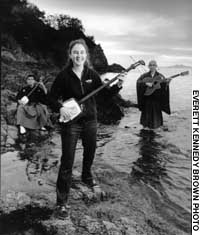
Water is an important element of the music played by (from left)
Chikuzen Tanaka, Catriona Sturton and Soken Danjo.
"It all started with Yoshio Watanabe, the English teacher at my high school here in Fukuyama, [Hiroshima Pref.]" Sturton says. "He invited me to get involved in a local old-houses restoration project. It was through this group that I met Danjo-san and Tanaka-san."
Buddhist priest Soken Danjo and local shamisen master Chikuzen Tanaka were producing a nonprofit CD recording of traditional Japanese healing music, for distribution to hospice programs around Japan. When he heard that Sturton had been a member of a popular indie rock band in her college days, Danjo invited her to join the chorus featured on the CD recording.
"That was the first time I visited a Buddhist temple," says Sturton. "It was a cold winter night, and the room was dark and mysterious. People involved in the recording were huddled around stoves, and when I heard Tanaka-san playing the shamisen for the first time, the experience left a profound impression on me."
It took another eight months for Sturton to pick up the three-stringed Japanese instrument for the first time.
"At the time I was busy playing bass guitar with a punk rock band in Fukuyama," says Sturton. "I was also jamming regularly with local country music, reggae and blues groups. Because I couldn't speak Japanese, I thought it would be too difficult to learn the shamisen. But when I heard a young performer at a local festival the following summer, I knew I wanted to give it a try. As a bass player, what I found really powerful was the lower tone of the shamisen."
Danjo, a skilled guitarist, sometimes invited Sturton to join blues sessions at his home. He suggested Sturton talk with Tanaka, who offered her a good deal on a used shamisen and began to give her lessons in the Tsugaru-jamisen tradition.
"A Japanese friend had warned me about studying shamisen," Sturton says. "They said most teachers were strict and expected their students to be serious. I was worried about that, but my teacher later told me that the relationship between teacher and student is like that of a mafia boss and his underlings. He suggested I watch yakuza movies to understand this. When we were not practicing, his wife and he were very lighthearted. They have a good sense of humor."
- snip -
How has the shamisen influenced Sturton?
"It's pretty difficult to describe how I feel when I play. In Japanese there is a word, mushin, that means 'nothing heart.' It's a kind of inner calm that I experience when I play the shamisen. As for studying with my teacher, anytime you meet somebody who is doing what they love for a living, I think that it is a great positive influence. It reminds you that there are so many paths to choose in life. After finishing the JET program, I'd like to study with him full time for at least six months and then create the opportunity for us to go on concert tour around Canada."
source : www.japantimes.co.jp
cold winter night -
remembering friends
with a warm heart
Gabi Greve, January 2012
.................................................................................
cold winter night -
remembering a friend
with a sad heart
January 9, 2013
I had a call from Danjo san today.
Chikuzen has passed away a few days ago, after a battle with cancer.
Just this morning, before the phone call,
I had introduced the Shamisen to my haiku friends in Facebook and spent a few minutes with all the fond memories . . . and then . . .
:::::::::::::::::::::::::::::::::::::::::::::::::::::::::::::::::::::::::::::::::::::::::::::::::::::::

Two geisha and a maid carrying a samisen box walking
Kitao Shigemasa
:::::::::::::::::::::::::::::::::::::::::::::::::::::::::::::::::::::::::::::::::::::::::::::::::::::::
- quote
Tokyo Shamisen
■ Traditional Technologies and Techniques
1- A Tokyo Shamisen is comprised of three major components. These are joined together by tenon and mortise joints. 継手(つぎて)
2- Ayasugibori 綾杉彫り (the carving of wavy resonance patterns) occurs after the instrument's stop has been cut. The backside of the wood used to make the body of the instrument is chiseled away. A namazori 生反 (spear-shaped chisel) is then used to further shave down the back side of these pieces. Using yet another chisel carefully creates the distinctive ayasugi patterns. During this process, extreme care is taken in order to prevent even a single error occurring.
3- After the four pieces that will make the body of the instrument have undergone ayasugibori, they are joined together using nikawa glue 膠(にかわ). Being created from hardwood and fashioned in ellipse shapes, these pieces are affixed together using only glue with no metal fittings. Thus, the glued contact surfaces of the pieces must be precise.
4- The skin stretched to cover the instrument's sound hole is especially prepared. To moisten the skin, it is wrapped in a damp cloth that has been thoroughly wrung out in advance to remove excess water. Special clips called kisen 木栓(きせん) are then used to mount the skin on a stretching device called a haridai. Chords are then slowly tightened to stretch the skin over the sound hole.
■ Traditionally Used Raw Materials
Redwood, red sandalwood, oak, rosewood (karin), mulberry, skin (cat, dog), raw silk.
紅木(紫檀)、紫檀、樫、花櫚(かりん)、桑、皮(猫、犬)、生糸

■ History and Characteristics
The ancestor of the Japanese shamisen is the Chinese three-stringed shamisen. The three-stringed shamisen was created in China, it coming to be known as the snake-skin shamisen when passing to the Kingdom of the Ryukyus (modern Okinawa Prefecture) at the end of the 14th century as snake skin was subsequently used in its manufacture.
It is believed that the first shamisen examples appearing in mainland Japan were landed at the Port of Sakaino after being traded from the Ryukyus. This event occurred during the Eiroku Era (1558-1570) as the Muromachi Period (1337-1573) drew to a close.
At around that time, when players of the biwa (the Japanese lute) played snake-skin shamisen in accompaniment to kouta (ballads) and dances, they encountered the problem of snake skins tearing. After trying a number of different skins as possible replacements for snake skin, these musicians decided to use cat skin.
Thus came about the development of a unique Japanese shamisen that was strummed using the pick of the biwa.
During the Edo Period (1603-1868) at around the time of the Kanei Era (1624-1643), master shamisen craftsmen such as Kanda Harumitsu and Ishimura Omi began to appear on the scene. The appearance of such craftsmen contributed to the development of musical styles such as nagauta (epic Kabuki songs), gidayu (puppet theater recitations), icchubushi (dramatic recitations accompanied by shamisen), tokiwatsu (a kabuki narrative), kiyomotobushi and shinnaibushi (narrative pieces). These styles represent the basis of the modern shamisen musical repertoire. The manufacturing of shamisen also flourished at this time.
歌舞伎の長唄や、義太夫、一中、常盤津、清元、新内の邦楽
When a shamisen string is plucked, it leaves behind a distinctive sound (resonance) called a sawari サワリ. The musical effect of the sawari has linkages to the ethnic identity of the Japanese.
In that Japanese people tend to prefer intermediate colors rather than primary ones, it also seems that they prefer complex sounds that contain overtones rather than simple ones. Traditional materials used in the neck of shamisen include (Indian) redwood, oak, rosewood and mulberry, while cat and dog skin is also used to cover the sound hole of the instrument.
Tokyo Japanese Musical Instruments Association
- source : www.sangyo-rodo.metro.tokyo.jp
. List of Edo craftsmen 江戸の職人 .
shamisenshi 三味線師 Shamisen maker

Cats playing the Shamisen
Utagawa Kuniyoshi 歌川 国芳

CLICK for more Shamisen Ukiyo-E
:::::::::::::::::::::::::::::::::::::::::::::::::::::::::::::::::::::::::::::::::::::::::::::::::::::::
kigo for all spring

. shamisengusa 三味線草(しゃみせんぐさ)
"Shamisen plant"
Sheperd's purse, nazuna 薺
It reminds us of the plectrum of the shamisen player.

三味線の音のこぼれきて薄暑かな
shamisen no ne no kobore-kite bakusho kana
the faint sound
of a shamisen -
early summer weather
Tr. Gabi Greve
quote
http://weekly-haiku.blogspot.com/2007/07/40.html
:::::::::::::::::::::::::::::::::::::::::::::::::::::::::::::::::::::::::::::::::::::::::::::::::::::

source : zenmaitarow
And a Daruma sticking out his tongue!!
. snowed in -
Daruma having fun
on the shamisen .
:::::::::::::::::::::::::::::::::::::::::::::::::::::::::::::::::::::::::::::::::::::::::::::::::::::
- - - - - Matsuo Basho - - - - -
琵琶行の夜や三味線の音あられ
biwakoo no yo ya samisen no oto arare
quote
Song of a lute
in the night - sounds as though
hailstones are falling
This haiku was influenced by Po Chu I’s poem, ‘Song of the Lute’, which he wrote while in exile at Chiu-chiang. He had been moved by someone playing the p’i—p’a, a lute. Upon enquiry it proved to be a former singing girl, who had fallen upon hard times. The poem contained two lines
The big strings plang—planged
like swift—falling rain
The little strings went buzz—buzz
like secret conversations
Tr. and comment : Bill Wyatt
Written in 1684 貞亨元年.
Basho had spent the night in Ogaki at the home of
Kondoo Jokoo 近藤如行 Kondo Joko.
As one attraction of the haikai meeting, Nyoko had asked a blind shamisen player 座頭 to perform for them.
It reminded Basho of the chinese poem Hakurakuten 白楽天, Haku Kyo'i 白 居易 (772 - 846) and his poem Biwakoo 琵琶行.
There is also another version of this poem
雑水に琵琶聴く軒の霰かな
. zoosui ni biwa kiku noki no arare kana .
(summer) hail. falling on the eaves. sounds like a biwa lute. rice porridge
Nozarashi Kiko 野ざらし紀行
. Matsuo Basho 松尾芭蕉 - Archives of the WKD .
Kondoo Jokoo 近藤如行 Kondo Joko.
(? - ? 1708)
He was the first disciple of Basho in Ogaki 大垣. Also called 源大夫. As the last station of his trip to "Oku no Hosomichi" Basho wanted to reach the home of Nyoko, where he had stayed before. The home of Nyoko burned down in a fire in 1692 元禄5年9月4日.
Nyoko had left his position as a samurai and became a monk very early in life. He travelled a lot, just like his master, Basho.
Another hokku by Basho during his stay with Joko:
胡蝶にもならで秋経る菜虫哉
. kochoo ni mo narade aki furu namushi kana .
- - - - - Some poems by Joko:
霜寒き旅寝に蚊屋を着せ申
歯固に梅の花かむにほひかな
夜るの日や不破の小家の煤はらひ
宵の月西になづなのきこゆ也
涼しさやともに米かむ椎が本
鬼の子に餅を居るもひゐな哉
名月や西にかゝれば蚊屋のつき
何のあれかのあれけふは大師講
source : itoyo/basho
MORE - Biwa lute poems by
. Matsuo Basho 松尾芭蕉 - Archives of the WKD .
:::::::::::::::::::::::::::::::::::::::::::::::::::::::::::::::::::::::::::::::::::::::::::::::::::::
- - - - - Kobayashi Issa - - - - -
小乞食の唄三絃や夏の月
ko kojiki no uta sangen ya natsu no tsuki
a beggar child
sings to the shamisen -
summer moon
Tr. Gabi Greve
三絃に鳴つく許り千鳥哉
shamisen ni nakitsuku bakari chidori kana
plovers cry out
precisely to the rhythm
of shamisens
Tr. Chris Drake
This winter hokku is from the 10th month (November) of 1819, the year evoked in Year of My Life. Issa, in a somber mood after the death of his young daughter Sato, seems to be remembering his earlier life in Edo, since several hokku placed just before this one deal with Edo. The hokku preceding this one evokes the withered, frost-covered fields behind the Yoshiwara entertainment quarter where sex work was also legal, so this hokku, too, may deal with this area. Many of the oiran and other highly trained women entertainers in the Yoshiwara quarter were experts at the shamisen, a three-stringed instrument played with a wood or ivory plectrum that Portuguese traders compared to the lute but that is closer to the banjo in terms of the amplification created by its sound box and the twanging sound of its strings.
The Yoshiwara quarter stood alone in the fields on the northern edge of Edo, isolated from the downtown area by the shogunate because it, along with the theater district, was regarded as a "bad place." The strong, reverberating sounds of samisens that come from the quarter present a stark contrast with the rather quiet world of empty, frost-covered fields outside. There are, however, some bird cries. Not far away is a canal that leads to the big Sumida River, and plovers fly here and there along the embankment. Plovers are convivial birds that like to chat and move in small groups, and to Issa's ear, their cries seem to closely follow the sounds of the shamisens nearby.
The verb nakitsuku, to tearfully implore, is written with the character to weep (泣付く), but Issa uses a different character, one used for animal cries (鳴つく). He seems to be doing this to suggest that the plovers are not so much imploring as crying out in close response, as if they liked the shamisen sounds and wanted to reply or synchronize their own cries with them. The normal plover rhythms have disappeared, and a kind of choral relationship has taken their place. Since the plovers live near the Yoshiwara quarter, they seem to have become accustomed or even attached to the shamisen sounds. The same kind of symbiotic sound environment was also no doubt created in many other parts of Edo, since the shamisen was the most popular instrument in Issa's time and was played in all sorts of situations, including theaters and festivals, by men as well as women. Issa's hokku could work in any of these situations.
In the Yoshiwara the leading women were called either tayuu or oiran, so the shamisen shouldn't be associated exclusively with geisha. The word geisha meant "performing artist" and referred, for example, to renga and haikai masters as well as the top actors in a No or Kabuki troupe. Some less famous male geisha entertainers worked as male jesters and musicians in the Yoshiwara quarter and at private parties, and by Issa's time many women were also working discreetly as party performers, though the shogunate frowned on women appearing in public. Some female geisha even became ballad singers of long, original works. Since women were a minority, however, these women were usually called "women geisha." Many became independent, performing here and there in Edo, and some took on male patrons on the side, but they should not be confused with full-time sex workers. It was only after westernization began in 1868 that the word geisha became synonymous in the minds of many non-Japanese with female sex workers.
In Issa's time the shamisen was also called samisen and sangen, and the instrument in the hokku can be read in these three ways. The editors of Issa's Collected Works have added phonetic glosses here and there that give samisen for the characters Issa uses, but I have chosen shamisen instead. It is the only pronunciation included in the Japanese-Portuguese dictionary of 1603, and it remained the most common of the three pronunciations.
Below is a link to a woman shamisen teacher demonstrating how to play a short Edo shamisen piece that is usually performed during a Kabuki play to suggest plovers near a river. In Issa's time only men were permitted to be Kabuki actors or musicians.
http://www.youtube.com/watch?v=gwGVChEHXHo
This link shows a kind of emotional county shamisen style that was originally developed by wandering blind women goze musicians who in Issa's time performed in northern areas along the Japan Sea, some near Issa's hometown, so Issa may have heard shamisen playing in his hometown that was a bit similar to this. Today this style remains popular mainly in northern Aomori Prefecture, though it has recently been (re)gaining popularity around Japan due to the power of the media:
http://www.youtube.com/watch?v=w5rs7pfZuPs
Chris Drake
. Kobayashi Issa 小林一茶 in Edo .
. Plover (chidori) .
:::::::::::::::::::::::::::::::::::::::::::::::::::::::::::::::::::::::::::::::::::::::::::::::::::::::
[ . BACK to WORLDKIGO . TOP . ]
[ . BACK to DARUMA MUSEUM TOP . ]
- #shamisen #sangen #jabisen #okinawa -
:::::::::::::::::::::::::::::::::::::::::::::::::::::::::::::::::::::::::::::::::::::::::::::::::::::



 Posts
Posts



4 comments:
琵琶行の夜や三味線の音あられ
biwakō no / yo ya samisen no / oto arare
Matsuo Basho / Shamisen
31 Tokyo Shamisen (Three-Stringed Musical Instrument)
東京三味線
Kobayashi Issa
三弦のばちでうけたり雪礫
samisen no bachi de uketari yukitsubute
blocked with her
samisen's plectrum...
snowball
Issa copies this haiku in one text with the prescript, "Brothel music." Prostitutes are having a snowball fight, and even the samisen player must fend off attackers.
David Lanoue
.
Kobayashi Issa
The hot springs bath is located deep in a mountain valley, yet you can always hear the sound of music being played. Even my old heart becomes excited, and I feel as if I were entering the grotto of immortal Daoist goddesses described in a Chinese novel. The sight of the dancing goddesses Jūjō and Gosō and the voices of singing courtesans and women entertainers cause blossoms to bloom in the midst of winter. I can only agree with Saint Shōkū, who once, long ago, came across a courtesan and soon realized she was the manifestation of a bodhisattva. Truly, when people go upstairs in the bathhouse they are able to forget all their pain and troubles, at least for a little while. It is a mysterious world very different from our daily life.
三絃のばちで掃きやる霰哉
samisen no bachi de haki-yaru arare kana
shamisen plectrums
flicking away
hailstones
This hokku appears in a haibun Issa wrote when he visited the Yudanaka hot springs in the mountains of Shinano, not far from his hometown, in the twelfth month (January) in 1822. The hot springs owner and his son were both Issa's haikai students, so he was always welcome there. The section of the haibun prefacing the hokku is translated above the hokku.
The Chinese novel Issa refers to is The Grotto of Playful Goddesses (Youxianku, in Japanese Yūsenkutsu), written by Zhang Zhou (660-732). The short novel was widely read for centuries in Japan, and Issa must have read at least a Japanese translation, since he uses the names of the two main goddesses (in Japanese pronunciation) in his haibun. It is the story of an imperial messenger sent to the upper reaches of the Yellow River who is forced to stop and beg for shelter at a house in the mountains as the day comes to a close. The house turns out to be owned by two women, actually Daoist goddesses, who allow him to stay. The women treat him to a great drinking party and banquet, with much singing and dancing, and numerous amorous and often erotic poem exchanges take place between the man and one of the goddesses. With the help of the other owner goddess and many helper goddesses, the man and woman finally are able to sleep together for a short time, only to be woken by roosters all to soon. The lovers part with great reluctance, since the messenger must deliver his message, and the moving final scene of their parting is evoked with just as much poetic intensity as the novel as a whole. Issa must have been impressed by the way Chinese prose and metered poetry are used in a balanced way in this novel, which is almost a kind of Chinese haibun.
There is no hail in the Chinese novel, but the remote mountain setting is the same as in the hokku. The hail here seems to blow inside the lounge on the second floor of the hot springs bathhouse visited by Issa. Probably the hot air from the first floor bath makes the second-floor lounge where the women musicians are playing rather warm as well, so some of the sliding doors are kept open to the veranda outside. To Issa the musicians seem almost like goddesses, and the hail coming down from the sky adds to the otherworldly quality of their playing and singing. Depending on the number of musicians, in addition to shamisens there may be a koto zither, a small drum, or even a flute. Probably at least two of the musicians are playing shamisens (see photo below), and when hailstones bounce onto their laps or onto the mat floor nearby, they smoothly and easily whisk them away using their plectrums. Looking both elegant and very skillful and professional, as if they were making music with hailstones, they hardly miss a beat, and even this sight seems heavenly to Issa.
Chris Drake
Post a Comment