:::::::::::::::::::::::::::::::::::::::::::::::::::::::::::::::::::::::::::::::::::::::::::::::::::::
Apsara, Apsaras, Heavenly Maidens
tennnyo 天女, hiten 飛天 flying apsaras, divine nymphs

This is a hand-painted copy from the walls of the Stone Caves at Dunhuang, China.
I bought it more than 15 years ago at the local museum, where these reproductions are sold quite expensively as a contribution to the preservation effort of the caves.
The painters sit in the cold caves for hours and meticulously copy the wall paintings, including the fadings and spots and missing parts. They are young aspiring painters who also make a living out of this work.
For more about Dunhuang read the LINK of Mark Schumacher below.
This page contains many photos, please be patient while they are uploaded.
:::::::::::::::::::::::::::::::::::::::::::::::::::::::::::::::::::::::::::::::::::::::::::::::::::::
The Symbol of Dunhuang, a Heavenly Maiden
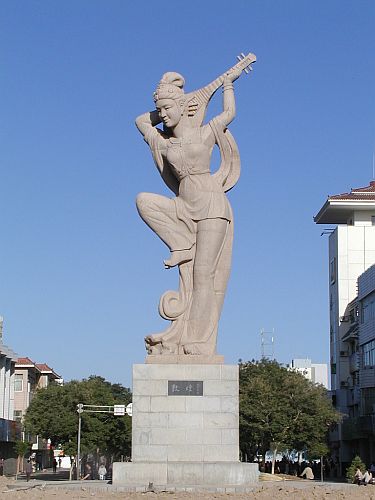
敦煌のシンボル : 「反弾き琵琶の天女像」
Look at many more photos from the area (Text in Japanese)
http://www.pluto.dti.ne.jp/~kennyko/SILKROAD/DUNHUANG_D4_4.html
:::::::::::::::::::::::::::::::::::::::::::::::::::::::::::::::::::::::::::::::::::::::::::::::::::::
Some Apsaras, taken from this book:
敦煌石窟, 敦煌文物研究所/平凡社 1982
The photos will give you an impression about the changes of painting style, colors used during the ages and the kind of abstraction used. Some of them look like modern art to me.
One of the major problems of wall painting at these times was to find the appropriate mineral colors that would last for a while.
Northern Liang Dynasty (421 - 534)


Western Wei Dynasty (535 - 556)


Northern Zhou Dynasty (557 - 581)

Sui Dynasty (581 - 618)


Early Tang Dynasty (618 - 712)
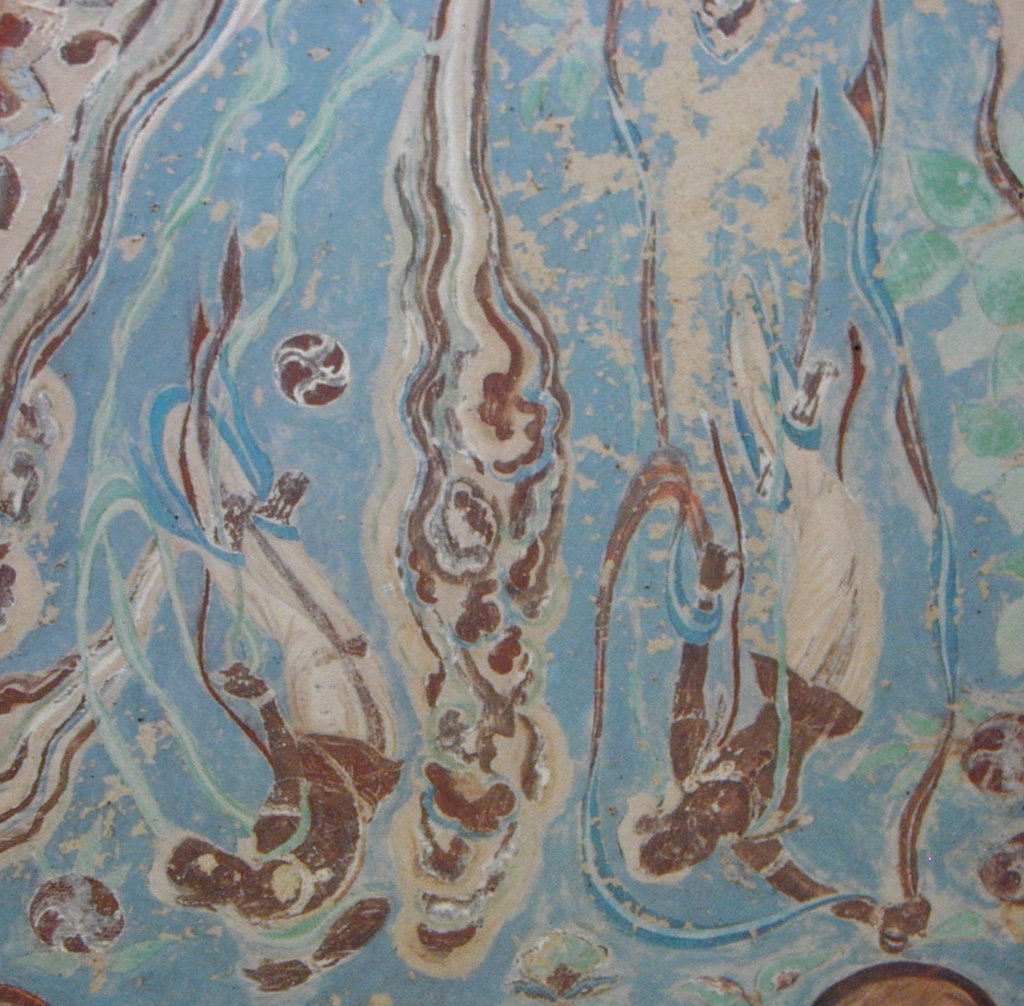
Prosperous Tang Period (712 - 781)

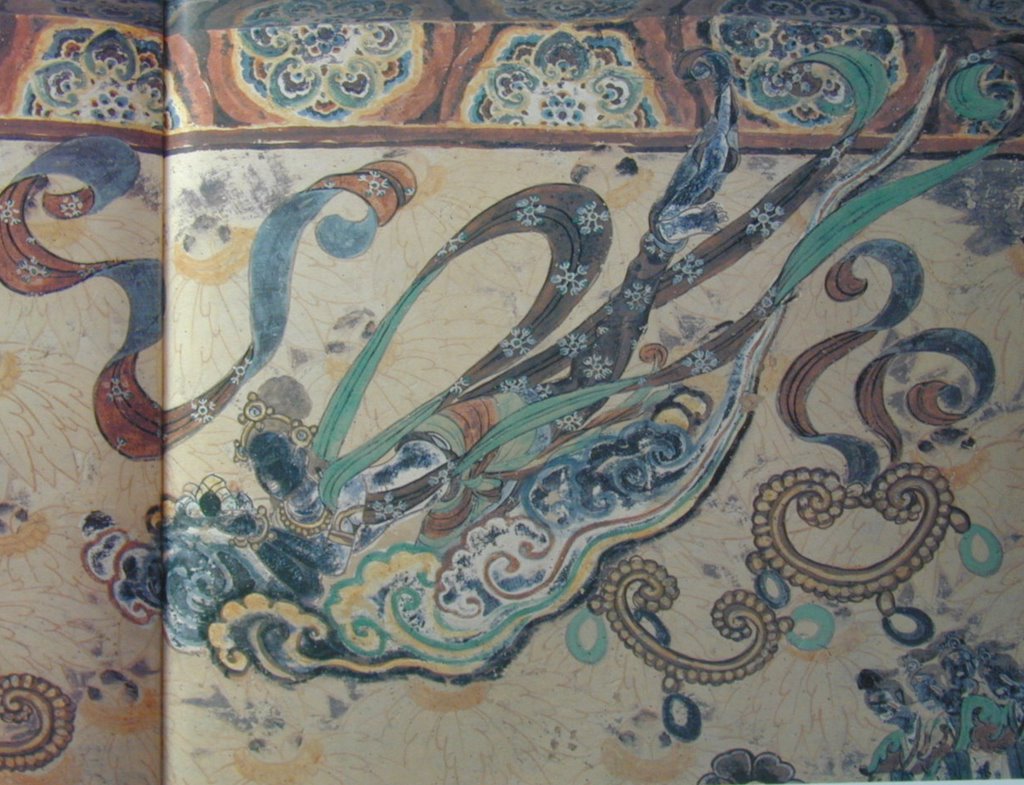
........................ Musician Bodhisattvas


Later Tang Dynasty (848 - 907)

Northern Sung (Song) Dynasty (960 - 1036)

Photos taken from the following book:
Tonko Bunbutsu Kenkyujo Hen;
Kanshu Chugoku Sekkutsu Tonko Bakkookutsu Henshu Iinkai.
Tokyo: Heibonsha, 1980-1982
( Chinese Cave Temple Series: The Mogao Caves at Dunhuang)
oo oo oo oo oo
Further reading in the Daruma Library
Apsaras and Musical Instruments, by Chen Lin

DUNHUANG STUDIES - by Prof. Ning Qiang
with more photos
:::::::::::::::::::::::::::::::::::::::::::::::::::::::::::::::::::::::::::::::::::::::::::::::::::::
The musical instruments shown with these apsaras are now revived in China and used in orchestras.
Here is a group with its instruments.
敦煌古楽器アンサンブル Tonko Ko Gakki Ensamble
http://www.chugei.com/tonkou/index.html
More LINKS with photos from the caves
http://www.pluto.dti.ne.jp/~kennyko/SILKROAD/MOGAO_D5_06.html
:::::::::::::::::::::::::::::::::::::::::::::::::::::::::::::::::::::::::::::::::::::::::::::::::::::
Tonko 敦煌 Dunhuang
More photos from my trip to Dunhuang
Photos from my Trip to Seian and the Gobi Desert
.......................................................................
Mystical Bird (Karyōbinga), 葛飾北斎 Katsushika Hokusai

Karyōbinga 迦陵頻伽 (Karyobinga) Skt. = Kalavinka
Celestial beings who play music, dance, and fly through the air. They appear in many forms, often with bird’s body and angelic head, and are sometimes associated with Amida Nyorai. They appear often in Buddhist paintings, ritual robes, murals, and temple decorations.
Celestial Maidens : Look at many more photos and
read Mark Schumacher.
Mark will tell you all the necessary information about this subject.
:::::::::::::::::::::::::::::::::::::::::::::::::::::::::::::::::::::::::::::::::::::::::::::::::::::
I dedicate this page to Prof. Dietrich Seckel
my professor of East-Asian Art at Heidelberg University.
He told us about Dunhuang and the apsaras with so much enthusiasm, that it has since then been my wish to see them for myself.
Professor für Ostasiatische Kunstsgeschichte, Universität Heidelberg
Professor Seckel about the Apsaras
Heilige Gestalten stehen in der buddhistischen Theologie und Kunst selten alleine, vielmehr sind sie mit anderen, die mit ihnen einen gedanklichen und kultischen Zusammenhang haben, zu ikonographisch ziemlich feststehenden Gruppen verbunden.
Zu jedem Buddha gehört ein oder meist zwei Bodhisattvas, in der esoterischen Schule auch ein Vidyaaraaja; ferner gehört zu ihm eine Gruppe beschützender und eine Gruppe anbetender Wesen (anbetende oder Weihgaben darbringende Bodhisattvas (kuyoo bosatsu) ) oder Apsaras, d.h. engelartige Himmelswesen, Adoranten, Jünger.
... aber auch wenn göttliche oder halbgöttliche Wesen im Akt der Verehrung erscheinen, wie vor allem die Apsaras, werden sie in oft lebhafter, anmutig schwebender, fliegender, tänzerischer Bewegung gezeigt; und zwar treten solche Bewegungen geschichtlich sehr früh auf - nämlich schon in der Wei- und Suiko-Zeit.
... engelartige (doch mit den alttestamentlichen oder christlichen Engeln gar nicht vergleichbare) Bodhisattvas, die zur Verehrung (puja, puuja) eines Buddha herbeischweben und ihm Blumen, Weihrauch, Musik und Tanz als Weihgaben darbringen.
Sie und die ihnen ähnlichen Apsaras werden oft recht unpräzise als "fliegende Himmelswesen", "heavenly beings" und dergleichen bezeichnet.
Quoted from
Buddhistische Kunst Ostasiens
Verlag W. Kohlhammer, Stuttgart 1957
Buddha Statues, Who is Who, by Gabi Greve
Reviewed by Prof. Seckel
:::::::::::::::::::::::::::::::::::::::::::::::::::::::::::::::::::::::::::::::::::::::::::::::::::::
Hindu Mythology
The Apsaras are female spirits of nature. Thye are usually water nymphs or forest spirits. They are considered very talented artistically, and all of them are described as being very beautiful. Apsaras love to dance and they often performed for gods.
While serving as inspiration for lovers, they were often sent by Ravana to tempt rishis or Brahmans who were retreating into the forest.
http://www.siamese-dream.com/reference/apsaras.html
Read more about Music of India and Haiku
snowflakes -
the heavenly crowds
descending
:::::::::::::::::::::::::::::::::::::::::::::::::::::::::::::::::::::::::::::::::::::::::::::::::::::
A Comment from Chris Cochrane
February 2006
Though the term "apsara" is not used, the heaven-flying maiden is the figure seen in Japanese paintings of the maiden Hagoromo-- (the maiden of the Feather Mantle). She flys over Mt. Fuji dropping feathers; these paintings are displayed at New Year's season.

The story of the bird maiden goes back to an 8th century collection of provincial topographies _Fudoki_ (source: http://www.shermanleeinstitute.org/exhibition-spring05.html). A group of birds changes into maidens to bathe in a lake. A man steals the feather robe (hagoromo) of the youngest, forcing her to marry him. After many years, she retrieves her gown and returns to the skies, leaving her husband and their children behind.
The later noh drama _Hagoromo_ tells of a fisherman who discovers the feather mantle of a heavenly maiden. The maiden asks him to return the garment to her. When he does, she rises into the sky dancing evocatively.
Feathers allude to good fortune (the return of a feathered "bat (homonym for luck)/birdie" in a paddle game) and perhaps to depiction of spirits descending through a natural object object (_yorishiro_ in Shinto belief), not unlike spirits descending to color the leaves from top to bottom in autumn as heaven's spirit descends to the dusty world in the Noh drama _Tatsuta_.
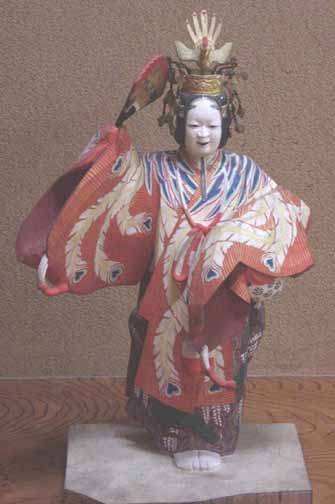
The dance of the maiden of the Feather Mantle is also replicated by the character of the Chinese historical beauty Yang Keui-fei (name changed) in the Noh drama _Yokihi_.
The International Shakuhachi website www.komuso.com/pieces/Hagoromo_no_Kyoku.html references this maiden. It includes the text of a poem set to koto music and notes: "One of the most profound of the kumi-uta that are classified into the deep interior (oku) category of the koto music repertoire (1), this song cycle 'Hagoromo no kyoku' ('Celestial Robes') is played frequently as part of the first musical event of the New Year Hikizome, a traditional ceremony that accompanies the First Reading, the First Writing and other ceremonies that begin the New Year in Japan."
2 photos are © by Chris Cochrane
:::::::::::::::::::::::::::::::::::::::::::::::::::::::::::::::::::::::::::::::::::::::::::::::::::::

source : www.threehares.net/
Mogao caves–
the hare with amber eyes
curls itself a timepiece
Triple hare symbols have been found at the caves.
Alan Summers
:::::::::::::::::::::::::::::::::::::::::::::::::::::::::::::::::::::::::::::::::::::::::::::::::::::
. Kikaku, Takarai Kikaku 宝井其角 Enomoto Kikaku (1661-1707) .
Enoshima Island 榎島
花風や天女負れて歩渡り
hanakaze ya tennyo owarete kachi-watari
blossoms in the wind --
a heavenly woman rides high
across the shallows
Tr. and comment : Chris Drake
Many different characters were used to write Enoshima. I think "heavenly woman" (tennyo) must refer to Benzaiten, an Indian female god associated with Buddhism who governs artistic ability, eloquence, knowledge, water, the ocean, and wealth. There is a famous shrine to her on Enoshima Island, not far from Edo. Benzaiten or, more commonly, Benten was worshiped by many Edo people, who often made pilgrimages to Enoshima Island, especially in spring. One of the two statues of Benten on the island is very famous and shows her playing a lute (biwa) naked. Benten is often referred to as a heavenly woman, and she is also represented by three Shinto gods, all sisters, so there were/are actually four heavenly women on the island -- and no male gods.
The meaning of the hokku is a little difficult, so this is just a first guess. The first line refers to the wind blowing cherry blossoms on the island and onto the sea around it. The last line seems to refer to walking to or from Enoshima Island across a narrow ridge in the shore that at low tide connects the shore with the island but at high tide is covered. The verb kachi-wataru (written both 徒渡る and 歩渡る) means to ford or wade through shallow water up to about two feet high, usually in order to cross a stream or shallow river.
As for the heavenly woman, I wonder if Kikaku isn't using the term metaphorically while at the same time referring to Benten. Perhaps the tide has started to rise, covering the natural walkway between the island and the shore, and one woman pilgrim in beautiful spring robes has hired a porter to carry her back to the mainland through the shallow water now covering the same ridge of sandy land she walked on earlier to get to the island. Or perhaps the women is traveling with a man, and now he carries her on his shoulders across the shallow water between the island and mainland at high tide.
To Kikaku the woman must look very beautiful, since he her calls her a heavenly woman. Or perhaps, a bit like the naked Benten statue, the woman has pulled up her robes so they won't get ruined by the salt water and parts of her thighs are now showing. At the same time, the blossoms scattering in the wind make the woman on the man's shoulders look a bit as if she were flying through the air like a heavenly being. I translate "carried" as "rides high," since I think Kikaku is suggesting a semi-flying image of the semi-heavenly woman. (Or there might be several women being carried/riding across, since number isn't marked here.)
Chris Drake
:::::::::::::::::::::::::::::::::::::::::::::::::::::::::::::::::::::::::::::::::::::::::::::::::::::

source : Hitoshi on facebook
at 高野山 Mount Koya
:::::::::::::::::::::::::::::::::::::::::::::::::::::::::::::::::::::::::::::::::::::::::::::::::::::
[ . BACK to WORLDKIGO . TOP . ]
[ . BACK to DARUMA MUSEUM TOP . ]
:::::::::::::::::::::::::::::::::::::::::::::::::::::::::::::::::::::::::::::::::::::::::::::::::::::



 Posts
Posts



17 comments:
Your haiku is telling and your Apsaras are lovely. . .
beautiful frescos and paintings.
her almond eyes . . .
beckons me to enter
Ajanta caves
K. from India
::::::::::::::::::::::::::::::::::::::::::::::::::::::::::::::::::::::
very nice Gabi,
and I enjoyed looking at the Apsaras also. Incredible.
Thank you, Nea.
flying apsaras -
a very purified representation
on the stone
¤
Nymphes en plein vol -
une représentation très épurée
sur la pierre
¤
Marcel Peltier, Belgium
::::::::::::::::::::::::::::::::::::::::::::::::::::::::::::::::::::::
The Maiden dances
Toward heaven unbound from stone
Joy flows through my heart
~ Edwina Peterson Cross ~
Indeed, my maidens dancing came from your photographs. The paintings on the walls of the stone caves are marvelous, so flowing and full of movement. They reminded me, in a way, of the figures on Greek vases, you can almost see the dance in motion.
I like the wall paintings very much, but I adore the large statue . . .
with her instrument behind her head, her foot up ready for the next stepof her dance and a look of such quiet delight on her face.
I came across your site while contemplating how many different haiku sites there are out there and I was entirely intrigued by the name and the concept behind it. In truth, I think I am drawn to haiku because it is sort of a polar opposite of the way I naturally write, which is long, flowing and lyrical.
. Read more here in Happy Haiku .
::::::::::::::::::::::::::::::::::::::::::::::::::::::::::::::::::::::
Thank you, Gabi.
The Asparas are really beautiful to look at. Thank you for all the information you've gathered.
I can imagine the moving whiteness in your haiku.
K. from WHCmultimedia
::::::::::::::::::::::::::::::::::::::::::::::::::::::::::::::::::::::
Thanks, Gabi san...
I'd never heard of the Apsaras --
what fascinating history!
(And I still don't know how you
find the time for all this compiling!)
Your snowflake haiku is just lovely!
:~)
WHCmultimedia
::::::::::::::::::::::::::::::::::::::::::::::::::::::::::::::::::::::
Enjoyed visiting your site --Daruma San in Japan.
It evoked the following haiku which I wish to share with you:
Diving in the sky
apsaras on the Stone Caves --
god-touch in motion
R.K.SINGH, India
::::::::::::::::::::::::::::::::::::::::::::::::::::::::::::::::::::::
Thanks for including my Apsara haiku on your blog.
R K
Dear Gabi,
Thank you for a wonderful article and images of Chinese apsaras. Please visit my research site at Devata.org to meet some of their Khmer sisters. (-:
With best regards,
Kent
Thank you very much, Kent, for sharing your beauties with us!
Gabi
人戀へば志功の天女冬の燈に
hito koeba Shikoo no tennyo fuyu no hi ni
if you are in love
the Apsars of Shiko
are a light in winter
河野多希女 Kano Takijo
桃咲くや志功天女の腰ゆたか
momo saku ya Shikoo tennyo no koshi yukata
peach are blossoming -
the Apsaras of Shiko
have bulging hips
加藤いろは Kato Iroha
.
Munakata Shiko 棟方志功
http://fudosama.blogspot.jp/2011/12/munakata-shiko.html
Dunhuang: Buddhist Art at the Gateway of the Silk Road
April 19 – July 21, 2013
This exhibition will feature work found in the caves of Dunhuang, including sutras (Buddhist scriptures on paper scrolls), high-relief clay figures, wooden sculpture, silk banners, and molded bricks from the golden eras of the Northern dynasties (420-589) and Tang dynasty (618-907). To re-create the magnificent cave settings, a replica cave from the 8th century that contains the beautiful Bodhisattva of the Mogao Caves and a central pillar from the 6th century will also be on view.
http://www.chinainstitute.org/gallery/dunhuang/
.
Dance at Dunhuang: Part One
By Joseph Houseal
Interview with Mme Wang Kefen
- snip
As nobody else submitted a list, in addition to seeing many important caves that are significant in their own right, we received a comprehensive review of the dance imagery at Dunhuang. No Western dance scholar has studied the dance imagery of the Mogao Caves in as much depth as I was allowed to do, for which I am grateful to Robert Ho, Wang Xudong, and Wang Kefen.
.
Wang Kefen:
Dance is an art of morphology—it defies the written word—hence artistic depictions become valuable. Dance activities have been present in every aspect of existence since primitive times, but it is only in China that the history of dance has been continuously recorded, both in words and in images. One of the challenges of translating my books is that they are full of ancient quotations, difficult even for Chinese to understand. The dance paintings at Dunhuang reveal a fixed pattern in terms of aesthetics, although they differ in costume, style, and gesture. There is inevitably at least one [painted] Buddha image in every cave, usually placed in [the midst of] a scene with adoring crowds, and a stage that is based on an emperor’s stage. I have seen this type of stage in Japan—it might have been used for Bugaku dance.*
.
WK: There is a recurring image of the Western Paradise at Dunhuang in which an elevated Buddha is attended by holy courtiers, entertainers, musicians, and dancers, painted lower down. Right at the top, “sky spirits” called feitian fly, doubtless in imitation of old dance forms. These dancing images are found not only at Dunhuang, they are all over China in many cave sites. I have traveled and studied the Indian Buddhist cave sites at Ellora and Ajanta—no flying feitian! The movement of these airborne devas and their invention originate in Central China.
- snip -
JH: There seems to be at least two, maybe three, basic categories of dance depictions: the early Wei dynasty depictions, the Tang dynasty [618–907] heavenly court scenes, and scenes that look like village people dancing. Was there some kind of actual aristocratic dance assimilated from folk dance and other practices? That, after all, is how classical ballet came about in the West.
.
READ on
http://www.buddhistdoor.net/features/dance-at-dunhuang-part-one
.
Wonderful Dunhuang caves photos !
http://www.e-dunhuang.com/index.htm
.
Hiten to Tengu 飛天と天狗 Apsara and Tengu
. Kawanabe Kyosai 河鍋暁斎 (1831 - 1889) .
.
http://kappapedia.blogspot.jp/2016/08/ukiyo-e-with-tengu.html
.
a legend from Fukushima, 原町市 Haramachi
tenjin 天人 heavenly maiden
A man named from the Miura clan named 三浦左近国清 Miura Sakon Kunikiyo lived in 太田村別所 Ota village 別所館 Besshonotate. He went to the Fudo Waterfall at 馬場村 Babamura to pray for a wife. That night Fudo appeared in his dream and told him, that in this world there was no wife to fit him. He should go to the pond at 五台山 Mount Godaisan where the tenjin 天人 heavenly maiden come to bath and snatch one of their hagoromo 羽衣 feather mantles. Kunikiyo did as he dreamt, got the mantle and went back home. Soon the maiden came to his home and wanted her mantle back, but eventually she stayed on and became his wife. They had two sons and one daughter.
When the children had grown up, the maiden took her mantle, said good bye and went back to heaven. Kunikiyo was very sad and his daughter was even more sad. She eventually threw herself into the pond and died. Now there is even a stone memorial in her memory at the pond, 姫塚 Himezuka.
.
https://fudosama.blogspot.jp/2017/09/fudo-legends-03-fukushima.html
.
and 19 legends to explore
http://www.nichibun.ac.jp/cgi-bin/YoukaiDB2/msearch/msearch.cgi?index=&config=&hint=%E3%81%B2%E3%82%89%E3%81%8C%E3%81%AA&set=1&query=%E7%BE%BD%E8%A1%A3
.
Two nyosen 女仙 heavenly immortals
Udohama Nyosen 宇度浜女仙 female Sennin from Udohama beach
and 漁夫 her husband, a fisherman
- and the story of Hagoromo (the Feathered Robe)
.
Yoshinoyama Nyosen 吉野山女仙 Female Sennin from Mount Yoshinoyama
dancing for . Tenmu, Tenbu 天武天皇 Emperor Tenmu Tenno .
.
MORE in my blog
https://gokurakuparadies.blogspot.jp/2018/04/butsusen-02-udohama-03-yoshinoyama.html
.
Post a Comment