. yuurei 幽霊 Yurei ghost, Geist .
. kaijuu 怪獣 Kaiju - mythological beasts .
:::::::::::::::::::::::::::::::::::::::::::::::::::::::::::::::::::::::::::::::::::::::::::::::::::::
Japanese Ghosts and Ghost Stories
kaidan 怪談
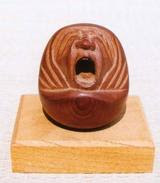
O-Bake, お化け, anything that is fearful or super-large or otherwise out of the normal range is called O-Bake. We grow huge pumpkins in the garden, O-bake kabocha.
There is, of course also
O-Bake Daruma お化け達磨 !!

From the side

http://ebikani.org/youkai/hariko/obakedaruma.htm
Here are a few more papermachee monsters to click and have fun:
http://ebikani.org/youkai/hariko/mokuzi.htm
.. .. .. .. .. .. ..
Here is another Monster Daruma, from a computer game.
出たー!お化け達磨
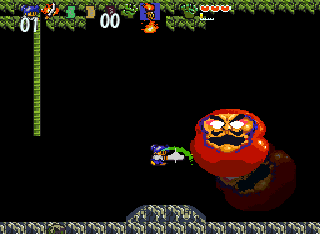
Look at some more photos here:
http://syarekou.hp.infoseek.co.jp/games/kiga5/kiga5.html
Copyright (c) 2001 Syarekoube
Now let us look at some of the more traditional Japanese Ghosts.
:::::::::::::::::::::::::::::::::::::::::::::::::::::::::::::::::::::::::::::::::::::::::::::::::::::
Lafcadio Hearn has introduced the Japanese Ghost Stories in his great book
KWAIDAN.
Kwaidan by Lafcadio Hearn - Project Gutenberg - to download
..................................................
. Yotsuya Kaidan 四谷怪談 The Ghost Story of Yotsuya .
Hanga by Hokusai about the lantern ghost of O-Iwa, the jealous wife.
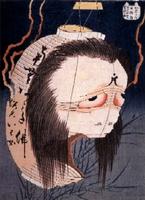
お岩さん 天保2、3(1831-32)年頃
葛飾北斎美術館
http://joho.ehime-iinet.or.jp/rekihaku/kakonotokubetutenji/
:::::::::::::::::::::::::::::::::::::::::::::::::::::::::::::::::::::::::::::::::::::::::::::::::::::

CLICK for more samples .
One Hundred Ghosts walking at Night
"Gazu Hyakki Yagyoo" "画図百鬼夜行”
http://d.hatena.ne.jp/asin/4309726089
There is a story about Fujiwara Tsuneyuki 藤原常行 (863 - 875).
He ventured out at night to meet his sweetheart in Eastern Kyoto, although his parents had asked him not to frequent this region. In the dark he happened to see the march of the 100 demons - oh dear !
He runs away in fear toward the Northern Gate of the Shinzen 神泉 cemetary, but the demons come after him. Still they can not harm him, because his mother had swen a magical mantra, 尊勝陀羅尼 (sonshoo darani), into his robes to protect him.
source : ja.wikipedia
:::::::::::::::::::::::::::::::::::::::::::::::::::::::::::::::::::::::::::::::::::::::::::::::::::::
Record of One Hundred Goblins,
by Kyôsai, Kyoosai Kawanabe
hyakki gadan 百鬼画談

http://www.city.koga.ibaraki.jp/rekihaku/hyakki.htm
In this woodblock-printed book by the gifted Meiji artist Kawanabe Kyôsai (1831-1889), the tradition of telling ghost stories is shown. On certain nights, especially in the summer, people gather together to tell ghost stories by the light of one hundred string wicks burning in an oil lamp.
As each story is told, one of the wicks is extinguished, thus making the room darker and darker. At the conclusion of the hundredth story, the room is thrown into darkness--and a spirit is said to appear.
http://www.loc.gov/exhibits/ukiyo-e/images/8728s.jpg
http://www.loc.gov/exhibits/ukiyo-e/images.html
:::::::::::::::::::::::::::::::::::::::::::::::::::::::::::::::::::::::::::::::::::::::::::::::::::::
Thirty-six ghosts by Taiso Tsukioka Yoshitoshi
新形三十六怪撰

prints were published from 1889 until 1892.
Yoshitoshi's Strange Tales
by John Stevenson
source : Jan van Reek
. Tsukioka Yoshitoshi 月岡芳年 .
:::::::::::::::::::::::::::::::::::::::::::::::::::::::::::::::::::::::::::::::::::::::::::::::::::::
Hokusai made a great collection of 100 monster prints
One Hundred Ghost Stories
(Hyaku monogatari 百物語)
kigo for late summer
One of my favorite is the Dish Mansion (Sara yashiki 皿屋敷)

© Tokyo National Museum
http://www.tnm.go.jp/en/servlet/Con?pageId=B01&processId=01&event_id=2040
More about the One Hundred Ghost Stories
http://www.aisf.or.jp/~jaanus/deta/h/hyakumonogatari.htm
. お菊と焼継屋 O-Kiku and the Yakitsugiya .
歌川広重 Utagawa Hiroshige - and the surprised pottery repairman
... a Japanese ghost story (kaidan) of broken trust and broken promises, leading to a dismal fate ...
:::::::::::::::::::::::::::::::::::::::::::::::::::::::::::::::::::::::::::::::::::::::::::::::::::::
Scroll of Monsters Yookai Emaki 妖怪絵巻

Look at them all here:
http://www.rekihaku.ac.jp/kikaku/index59/
And the collection of monster painting of the kids
http://www.rekihaku.ac.jp/kikaku/index59/emaki/index.html
. Buson Yokai Emaki 蕪村妖怪絵巻 Buson Monster Scroll .
. Yosa Buson 与謝蕪村 (1715 - 1783) Painter and Poet .
:::::::::::::::::::::::::::::::::::::::::::::::::::::::::::::::::::::::::::::::::::::::::::::::::::::
Old Household Tools, Tsukumogami 付喪神
According to "Yin-Yang Book", more than 100-year-old tools get souls and disconcert the public. Those tools are called Tsukumogami. At every beginning of a new year, the event called Sweeping soot is held in which old tools are thrown away on an alley.

http://ddb.libnet.kulib.kyoto-u.ac.jp/exhibit-e/otogi/tsukumo/tsukumo.html
After reading the explanation about the spirits of the old tools I finally understood why second-hand is such a hard business in Japan. Nobody wants to get the vengeful spirit, that might come with an old cupboard or shoe. Most old belongings of a dead person are ritually burned.
When we moved into the old farmhouse, we had a long purifying ceremony to make sure that Grandpa, who lived there all his life, would not stay with us for ever... Now, I guess, he is happily looking down at the Paradise Hermitage, GokuRakuAn.
Here is another link to it:
... many people were frightened at the possibility that their objects might come alive and present new problems for them, so they would often throw them away when they reached 99 years. Because of this, when the items did come alive, they would sometimes be angry that they had been thrown out after being used so long. They would band together and oftentimes go back and scare the people who had thrown them out, for being so wasteful.
http://www.youkaimura.org/tsuku.htm
. WKD - Ningyoo kuyoo 人形供養
Memorial Ceremony for old dolls .
- quote -
Understood by many Western scholars as a type of Japanese yōkai, the Tsukumogami (付喪神, "Kami of tools") was a concept popular in Japanese folklore as far back as the tenth century, used in the spread of Shingon Buddhism. Today, the term is generally understood to be applied to virtually any object, “that has reached their 100th birthday and thus become alive and self-aware,” though this definition is not without its controversy.
- - - More in the WIKIPEDIA !
. tsukumogami haiku by Yosa Buson 与謝蕪村 .
:::::::::::::::::::::::::::::::::::::::::::::::::::::::::::::::::::::::::::::::::::::::::::::::::::::
The Ground Spider, The Earth Spider
Tsuchigumo zooshi 土蜘蛛草紙 scroll

The story is from the Heian Period. Look at all the photos of this old scroll here.
.. longuemare.hp.infoseek.co.jp/tutigumo_...

.. .. ..
It became a great success as a Kabuki Play later on.
It was only in Meiji period, late 19th century when TSUCHIGUMO was arranged as KABUKI play. The beautifully costumed evil character Earth Spider and its performances of throwing paper threads like spider webs, won public popularity.

http://ueno.cool.ne.jp/mirukashihime/kabuki.htm

Tsukioka Kōgyo 月岡耕漁 Tsukioka Kogyo (1869-1927)
Mask of tsuchigumo 土蜘蛛, the Ground Spider
for the famous Mibu Kyoogen 壬生狂言 performance
. Mibudera 壬生寺 Mibu-Dera - Kyoto .

- kumo 蜘蛛と伝説 Legends about spiders / Spinnen -
:::::::::::::::::::::::::::::::::::::::::::::::::::::::::::::::::::::::::::::::::::::::::::::::::::::
Book about some - - - - - 怪奇鳥獣図巻 strange animals

Look at some more here:
http://www.kousakusha.co.jp/DTL/kaiki.html
... ... ...
The Old Chinese Sutra about Mountain and Sea Creatures
古代中国で編纂された地理と博物学の本『山海経』

http://www.chinjuh.mydns.jp/sengai/bovtigro/pa20.htm
Click on any of the clickable words.
http://www.chinjuh.mydns.jp/sengai/p01.htm
. kaijuu 怪獣 Kaiju - mythological beasts .
genjuu 幻獣 Genju, mysterious creature, cryptid
:::::::::::::::::::::::::::::::::::::::::::::::::::::::::::::::::::::::::::::::::::::::::::::::::::::
The Complete Database about Ghosts
In Japanese
このデータベースには、日本民俗学の文献から集められた怪異・妖怪伝承についての20,719件の書誌情報が入っています。
source : www.nichibun.ac.jp/youkaidb .
Animals, ghosts and Yōkai depicted in Ukiyo-e
source : through-the-sapphire-sky .
:::::::::::::::::::::::::::::::::::::::::::::::::::::::::::::::::::::::::::::::::::::::::::::::::::::
Quote from About Japan. Read more on these link pages. http://japanese.about.com/library/weekly/aa102800.htm Obake, Bakemono Literally means, "transforming thing." "O" is an honorific prefix and "bake" is a noun form for the verb "bakeru (to change, to transform)." It can also be used more generally to refer to anything that is weird or grotesque. Yuurei According to Shinto beliefs, all people have a soul called "reikon." When a person dies, the reikon leaves the body and joins the souls of its ancestors. However, when a person dies suddenly by murder, is slain in battle, commits suicide, or when he or she hasn't been given an appropriate funeral, the reikon may become a yuurei to seek revenge. Many yuurei are female ghosts who suffered badly in life from love, jealousy, sorrow, or regret. Male yuurei are less common. Yuurei usually appear in a white kimono (katabira), which people were buried in the old days, and have no legs. They also wear a white triangular piece of paper or cloth (hitaikakushi) on their forehead. They usually appear between 2 and 3 a.m. http://japanese.about.com/library/weekly/aa102800.htm I will tell you about "youkai," and look at the characters for them. Youkai literally means, "bewitching apparition." They include monsters, goblins, and ghouls. They usually appear at dawn or dusk. Unlike yuurei, which are the souls of the dead and downright scary, youkai are comical, bizarre and mischievous in some way. Here are some youkai. Oni Oni, demons or ogres, are one of the most famous youkai. They are huge and have horns. The color of their body is red, blue, or black. They usually carry a big iron club (kanabou). They are best known for guarding the gate of Buddhist hell. They also often appear in folktales. (Momotaro, Issun-boshi etc.) They are dumb, cruel, and malicious. On Setsubun (Feb. 3rd), there is a custom to drive away evil sprits. People scatter soybeans outside of doorways, shouting "Oni wa soto, Fuku wa uchi! (Demon out, Good luck in!)." Kappa Kappa are supernatural creatures which live both on land and in water. They are as tall as a four or five year old child. They have a beak-like snout, and fins on their hands and feet. They also have a shell on their back, and a water-filled dish on their head. As long as the dish is full of water, kappa keep their supernatural powers. Kappa are known for dragging people into the water and pulling out their livers through their anuses. Although kappa harm people sometimes, there are also many tales where they have helped people. They are very curious. They often appear in cartoons because of their lovable images. Kappa love sumo wrestling and cucumbers. That is why cucumber sushi rolls are called "kappa maki". "Okappa" are bobbed hairstyles because they look like the kappa's hairstyles. Kappa are excellent swimmers. There is a saying "Kappa no kawa nagare (a drowning kappa)" which means, even an expert can make mistakes sometimes. Rokurokubi Female monsters with long, flexible necks. They look just like ordinary humans during the day, but at night, they extend their necks to frighten or spy on people. They sometimes turn their human faces into those of demons. Yuki-Onna A snow woman, appears in a white kimono on a stormy night. She causes travelers to become lost and freeze to death. Click here to read the story of "Yuki-Onna" by Lafcadio Hearn (Koizumi Yakumo). Hitotsume-Kozou A one-eyed goblin, literally has a large eye in the center of its face. It looks like the shaved head of a priest. It does not play tricks, but just scares people. Tengu Tengu is also a youkai. Click here to read about "tengu." http://japanese.about.com/library/weekly/aa110400.htm |
- KAPPA - 河童 / かっぱ / カッパ - Water Goblin -
My Kappapedia
:::::::::::::::::::::::::::::::::::::::::::::::::::::::::::::::::::::::::::::::::::::::::::::::::::::
Read Mark Schumacher about
Amano Jyaku Amanjaku、Amanojaku 天邪鬼
Fox (Oinari) お稲荷さま
Kappa 河童
Tengu 天狗
ONI (DEMONS) in Japanese Buddhist and Shinto Traditions
:::::::::::::::::::::::::::::::::::::::::::::::::::::::::::::::::::::::::::::::::::::::::::::::::::::
Some more links about the ghosts and monsters of Japan
Japanese Ghosts
By Tim Screech
The Japanese world of the supernatural comprises a dizzying array of characters, from the humorously bizarre to the downright terrifying. In the 18th century, Toriyama Sekien attempted to categorize the many different types of ghostly beings that inhabit the Japanese landscape, its heavens and its hells; the results of his efforts filled four huge volumes. Here, Tim Screech takes us on a slightly more abbreviated tour.
http://www.mangajin.com/mangajin/samplemj/ghosts/ghosts.htm
No-Masks List
Ghosts & Spirits
Hannya
Demons
http://www.pasar5.com/NOH_MASK/mlist.html
Ghosts, Demons and Spirits in Japanese Lore
Norman A. Rubin
The Realm of the Hell-Dwellers
A Buddhist Perspective
The eight hot hells and eight cold hells lie thousands of miles beneath the surface of the southern continent Jambudvipa. The major hells are stacked one on top of the other with the worst hell on the bottom.

The Wheel of Becoming
Bhavachakra artwork copyright by Ryuei. 2000.
http://nichirenscoffeehouse.net/ShuteiMandala/vedic.html
:::::::::::::::::::::::::::::::::::::::::::::::::::::::::::::::::::::::::::::::::::::::::::::::::::::
The vengeful spirits, goryoo, onryoo 御霊、怨霊
. Vengeful spirits, onryo

akuryoo 悪霊 evil spirit
悪霊がきてざわめきぬ黒葡萄
akuryo ga kite zawamekinu kurobudo
an evil spirit has come -
the black grapes are in uproar
Katsumi Ozawa 小澤克己
:::::::::::::::::::::::::::::::::::::::::::::::::::::::::::::::::::::::::::::::::::::::::::::::::::::
- - - - - Read my articles about
Bakeneko, the Monster Cat ... 化け猫
Oni, Japanese Demons ... 鬼 と美術
TENGU and DARUMA
Tsuchinoko, tsuchi no ko ツチノコ or 槌の子 Hammerspawn legendary reptile, almost a snake
Ghosts (yookai, bakemono) .. and haiku

Halloween, Hallowe’en , and kigo for haiku
:::::::::::::::::::::::::::::::::::::::::::::::::::::::::::::::::::::::::::::::::::::::::::::::::::::
Suggested further Reading
Japanese art is laden with images and allusions. Contemporary viewers may encounter difficulty recognizing the literary and historical allusions and other cultural codes embedded in early modern Japanese works. However, a more careful viewing leads to the exciting recognition that Japanese art covers themes familiar to Westerners and Easterners alike. The individual versus society; humanity and the forces of nature; this world vis á vis the Ultimate--are among the themes handled in Japanese art as they are in other cultures' artistic expressions.
Read a great exploration with many woodblock prints here:
http://www.loc.gov/exhibits/ukiyo-e/images.html
:::::::::::::::::::::::::::::::::::::::::::::::::::::::::::::::::::::::::::::::::::::::::::::::::::::
天野行雄さんによる妖怪民芸品4選
Exhibition of the Monster Folk Art by Amano Yukio

:::::::::::::::::::::::::::::::::::::::::::::::::::::::::::::::::::::::::::::::::::::::::::::::::::::

Pandemonium and Parade
Japanese Monsters and the Culture of Yokai
Michael Dylan Foster
http://www.ucpress.edu/books/pages/10977.php
:::::::::::::::::::::::::::::::::::::::::::::::::::::::::::::::::::::::::::::::::::::::::::::::::::::
. Oni 鬼 Demon Amulets .
. WASHOKU
Yookai 妖怪 Monsters and Japanese Food
. yuurei 幽霊 Yurei ghost, Geist .
[ . BACK to WORLDKIGO . TOP . ]
[ . BACK to DARUMA MUSEUM TOP . ]
- #tsuchigumo #spider -
:::::::::::::::::::::::::::::::::::::::::::::::::::::::::::::::::::::::::::::::::::::::::::::::::::::



 Posts
Posts




12 comments:
Oh so perfect for Halloween!
Fascinating reading as per usual from Gabi's blog.
D.
.
The vengeful spirits, goryoo, onryoo 御霊、怨霊
.
full moon on dark hills-
i remember
grand ma's ghost stories
Regards,
Sunil Uniyal, India
Thank you, Sunil !
“Japanese Ghosts and Eerie Creatures”
at the Osaka Museum of History
is mostly play, with little horror. This is because so much of the genre’s visual and thematic core was part of the spectacle of the stage in 17th-century kabuki theater, and among the wide variety of other prints and paintings you’ll find caricature, parody and comic invention.
The truly macabre is only a side show, as in the splattered bloody gore of “A Ghost Holding a Woman’s Head” by Keisai Eisen (1790-1848). Playful fiction is never far from spilling over into reality, however, as in the anatomical sketches that were used as visual evidence of “monsters” that terrorized Motogi village (in present-day Fukuoka) between 1680-84.
MORE
http://www.japantimes.co.jp/culture/2013/05/09/arts/the-ghouls-who-played-on-the-japanese-mind/#.UYrca0rOeE8
.
karakasa obake から傘お化け / 唐傘お化け umbrella ghost
.
Bakejizo, Bake-Jizo 化け地蔵 / 化地蔵 Jizo as a yokai monster
obake Jizoo お化け地蔵 O-bake Jizo
Goblins, Ghosts, and Ghouls in Japanese Prints
by Laura C. Mallonee, 2014
Unsurprisingly, these ghost stories piqued the artistic imagination, and many printmakers in 18th- and 19th-century Japan translated them into colorful woodblock prints. Some are now on view in the Art Institute of Chicago’s Ghosts and Demons in Japanese Prints, an exhibition not meant for the easily spooked.
.
http://hyperallergic.com/158516/goblins-ghosts-and-ghouls-in-japanese-prints/
Kikyō na oni ni kobu o jyokosareu" "Strange demon cures a bumb";
町田康訳「奇怪な鬼に瘤を除去される」(『宇治拾遺物語』より)from the "Uji Shūi Monogatari"
Kawadeshobō publisher, Machida Yasu, ed/trans.
http://kawadeshobo.tumblr.com/post/129340109097/%E7%94%BA%E7%94%B0%E5%BA%B7%E8%A8%B3%E5%A5%87%E6%80%AA%E3%81%AA%E9%AC%BC%E3%81%AB%E7%98%A4%E3%82%92%E9%99%A4%E5%8E%BB%E3%81%95%E3%82%8C%E3%82%8B%E5%AE%87%E6%B2%BB%E6%8B%BE%E9%81%BA%E7%89%A9%E8%AA%9E%E3%82%88%E3%82%8A
Yosa Buson
古池に草履沈みてみぞれかな
furu-ike ni
zoori shizumite
mizore kana
In an old pond
a straw sandal half sunken --
wet snow!
Tr. Shiffert
-----
Straw sandal
half sunk in an old pond
in the sleety snow.
Tr. Robert Hass
-----
Buson was quite fond of 付喪神 Tsukumogami.
Someone had cast away the old sandal and the sleet gave the atmosphere of lonelyness, even remembering Basho in the first line.
https://edoflourishing.blogspot.jp/2013/06/buson-yosa-buson.html
.
The cut marker KANA is at the end of line 3.
.
Rokurokubi, Rokuro-Kubi ろくろ首 "moving head"
.
https://kappapedia.blogspot.jp/2017/05/kidan-demon-stories-talk.html
.
Hyakki Yagyo scroll in the Iwase Bunko Library Collection.
Artist unknown, believed to date to late 19th century.
http://iwasebunko.jp/stock/collection/entry-198.html
.
Yokai Daruma
Dog Together x DemonCraft x 夥伴玩具 Partner Toys
.
https://omamorifromjapan.blogspot.com/2017/03/yokai-monsters-art-motives.html
.
Post a Comment